Community Foundations and the Farm Stop Model: Mill Street Market in Hastings, Michigan
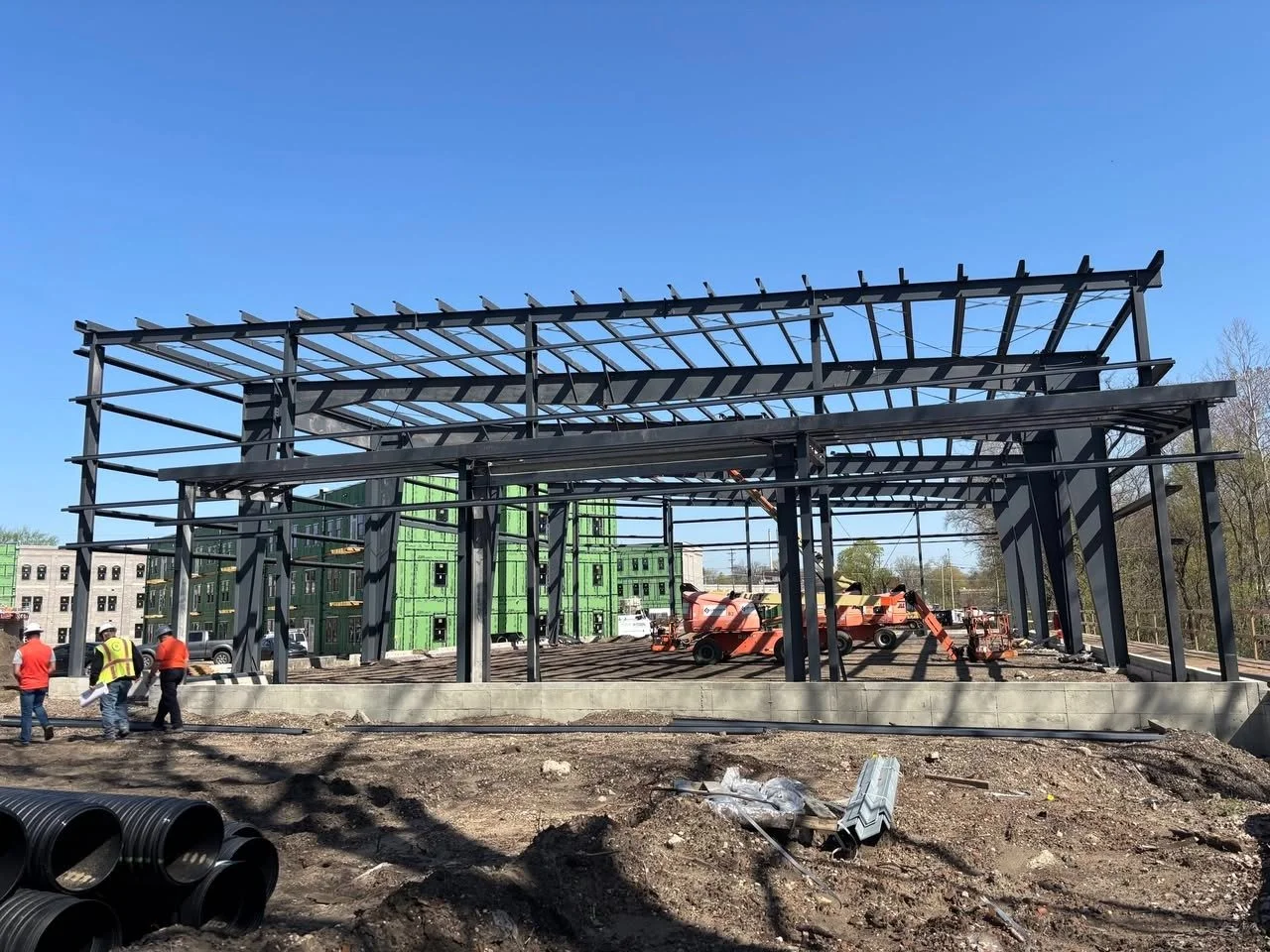
The structure that will house the Mill Street Market farm stop was erected in April, 2026. In the background can be seen the first phase of the 135 unit Riverwalk Lofts, which are part of the same $38M redevelopment project in Hastings, Michigan.
May 2026
Author: Mark Maynard
MARK: As of right now, there are a few community foundations around the United States that are thinking about making investments in farm stops. As your community foundation, in Hastings, Michigan, is now pretty far down that path, having raised approximately $7M to complete a development project that will include a farm stop, I’d like to talk with you about how the project came together, what the process has been like for you, and what you find compelling about the farm stop model. Before we get into that, though, can you tell us a little bit about Hastings?
BONNIE: The town of Hastings is the county seat of Barry County, Michigan. It sits along the Thornapple River and has a population of roughly 7,500 people. Barry County has a population of 65,000 and boasts other communities that have the same rural character and charm as Hastings. These towns include Nashville, Middleville, Delton, and Woodland. We are also centrally located between Kalamazoo, Battle Creek, Lansing, and Grand Rapids, making our communities go-to destinations for those wanting to enjoy beautiful rural topography and trails.
MARK: And what can you tell us about this ambitious development project of yours?
BONNIE: This project, as you see it today, is very different from when it started. It started with the site. Here, in Hastings, we had a beautiful, vacant two-story building that had once housed the Hastings Table Company and Royal Coach, a manufacturer of travel trailers. After the Royal Coach closed, Hastings Manufacturing acquired the property and used it as a warehouse. In 2015, the Hastings Community Foundation was approached by a local philanthropist about the possibility of purchasing the property at below market value and using it as the site for an affordable housing development. Unfortunately, in 2020, the building was targeted by an arsonist, which, in turn, led to contamination issues. So every part of this development is being built from the ground up, which wasn’t the original plan. Construction of the Hastings Riverwalk Lofts, though, is now underway.
MARK: How many apartments are being built on the site?
BONNIE: When completed, the site will house 135 apartments, from studio to three-bedroom. Those apartments will be in three separate buildings that overlook the Thornapple River.
MARK: At what point did the idea for the farm stop get incorporated into this larger affordable housing plan?
BONNIE: At about the same time we were working to find a developer to create this dense housing project on the property, the Blue Zones Project was completing its community scan of Hastings. Their objective was to identify ways to increase access to fresh, local foods. The study came back showing that there was a strong local desire for a year-round farmer’s market and event space. So, when we found a developer for the Riverwalk project, we negotiated this component as well. They committed to give us an allowance of $2-3 million so that we could design and construct the building that will eventually house the Farm Stop, a daycare, and a culinary arts facility that we’re working with our local school to create.
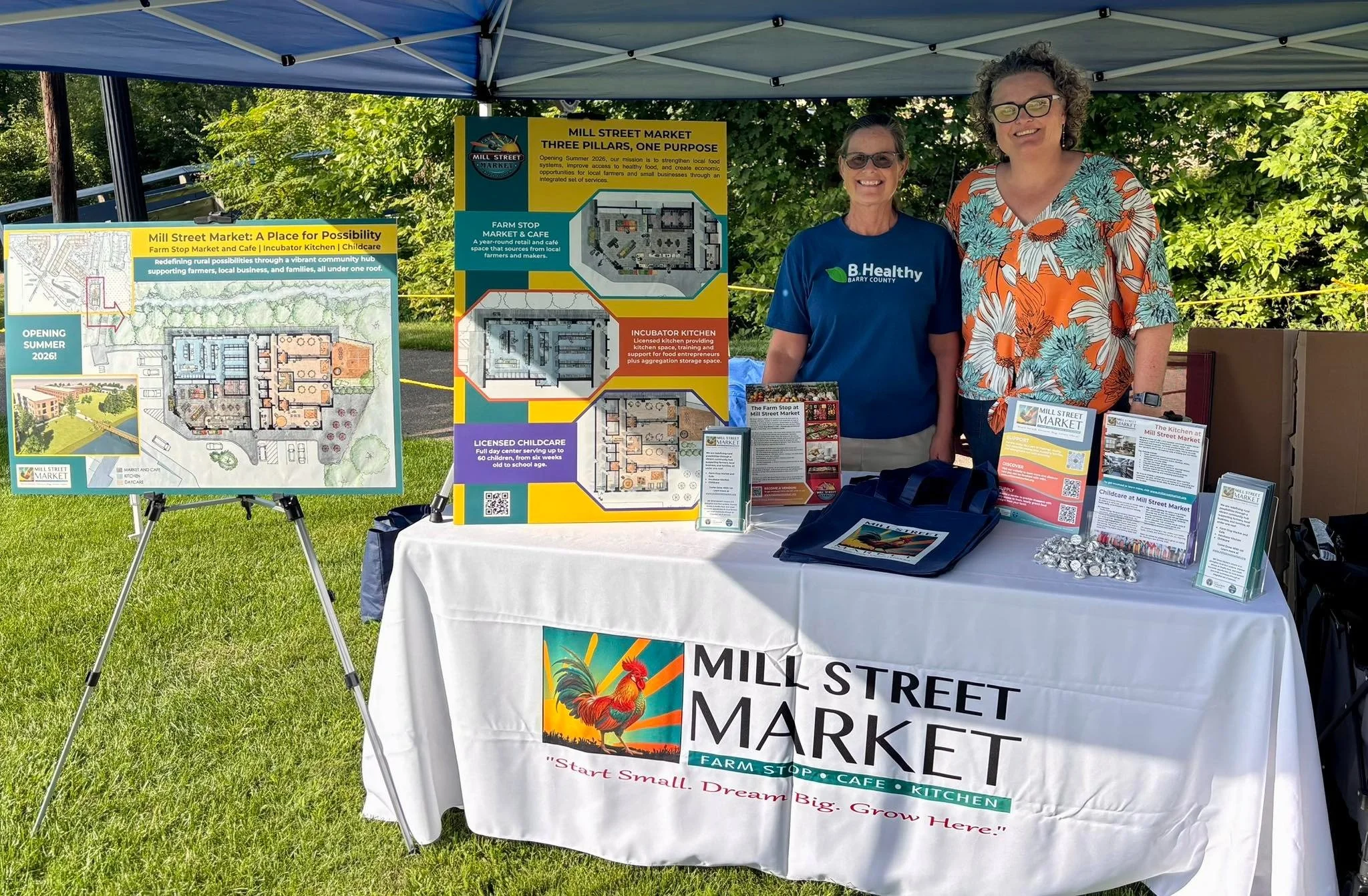
Catherine Getty, B. Healthy Barry County Executive Director and MSM board member, along with Allison Hinton, MSM Executive Director.
MARK: The developer gave you $2-3M to pursue these other initiatives on the site. How were you able to negotiate that? What did they get in return?
BONNIE: Honestly, it was a perfect storm. It’s a desirable site. It’s got high-visibility, and it’s walkable to downtown. So the developer was interested. As the foundation owned the property, the developers were ecstatic when we approached them about a community benefit building. It’s rare to have the mixed-use portion of a development identified and secured. And the Michigan Economic Development Corporation (MEDC) is really excited about this combination of community services!
MARK: OK, I think I’m starting to understand the bigger picture. The developer had received incentives from the MEDC, which required them to incorporate a community benefit component. And they were fortunate, in that you had already done the groundwork and had a vision for what might be possible. Is that it?
BONNIE: Exactly.
MARK: You mentioned Blue Zones. For those who might not be familiar, what is that?
BONNIE: The Blue Zones concept refers to five regions of the world where people consistently live longer, healthier lives — often reaching 100+ years — at rates far higher than the global average. The term was coined by author and researcher Dan Buettner in collaboration with National Geographic and demographers, and popularized through his 2008 book “The Blue Zones.” The five original blue zones identified were Sardinia (Italy), Okinawa (Japan), Loma Linda (California), the Nicoya Peninsula (Costa Rica), and Ikaria (Greece). Across all five zones, researchers identified nine common lifestyle factors. These include a predominantly plant-based diet, incorporating natural movement into one’s daily life, and a deep connection to one’s family and community.
MARK: It certainly sounds like the farm stop model is Blue Zone-friendly.
BONNIE: I would say that is why this project resonated with our local team. Making healthy the easy option is what we were going for.
MARK: Can you help us visualize the space the farm stop will be in?
BONNIE: That particular building will be a bit shy of 11,000 square feet, with each component sharing about one-third of the space. The site is directly across the river from our downtown and is accessible via a walking bridge. The first phase of the build is for one of the apartment buildings. They would like for those apartments to be available for rent in July. The market building is under construction as well. We are slated to begin on its interior this summer. The market’s projected opening is this November. I cannot wait to see it all completed.
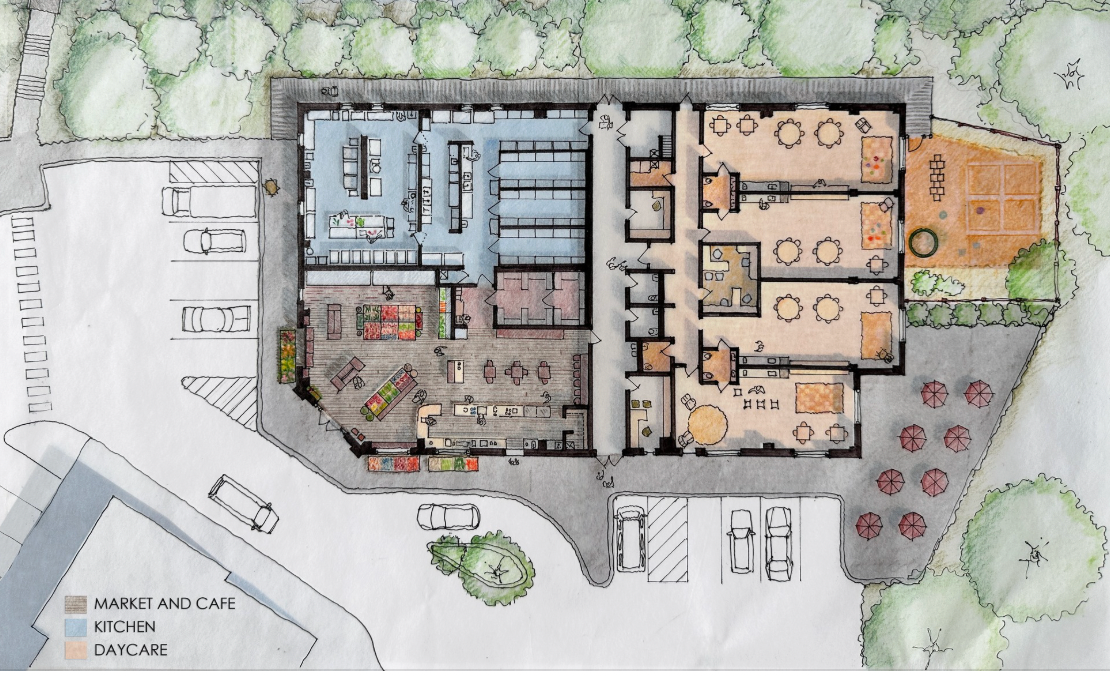
An architectural drawing shows how the space will be divided between the farm stop, the daycare facility, and the culinary arts facility.
MARK: You’ve obviously been very successful in raising local money for this project. As I mentioned earlier, you’ve raised about $7M for this component of the larger $38M project, and, if I’m not mistaken, almost all of that – aside from the funds provided by the developer – has come from local donors. What is it about this project, do you think, that resonated with your neighbors to such a degree?
BONNIE: We have a rich history of philanthropy here in Barry County. Those who have been blessed with economic security here tend to share their good fortune with others. The idea of a farm stop resonated with these community-minded folks, as did the idea of a daycare. They want new and innovative programs. And they liked that this project would help people and enhance local entrepreneurial opportunities. I also think that it helps that the foundation has a proven track record of success. Trust and relationships matter.
MARK: As I think you mentioned to me before, this isn’t the kind of project that you could have pulled-off 30 years ago, when you started your professional career. This is the kind of project that really required decades of trust-building, and relationships.
BONNIE: The capital campaign was really taxing. Getting the community buy-in for something this aggressive and impactful was the hardest work I have ever done. It takes a village.
[Mill Street Market manager Allison Hinton enters the conversation.]
ALLISON: I would add that this project simply wouldn't have been possible without Bonnie. She provided the momentum and support needed to move something of this scale forward. And so much of the community investment came because of the trust Bonnie has built in Barry County over the last 30 years. People know her. They know she shows up, follows through, and genuinely cares about this community. That trust and relationship-building became the foundation that allowed people to believe in this project and invest in it.
MARK: The last time you and I spoke, Bonnie, we talked quite a bit about one particular element of your fundraising campaign for this project. You found a donor who agreed to fund a unique matching grant program. For every household that gave any amount of money, this donor would give $1K. So a household could give $25, and the project would receive $1,025. It was such a brilliant way, I thought, to get the broader community involved, and encourage participation at every level. And it makes everyone who participates feel as though they have a real stake in this. Can you talk a little about the success of this campaign, and how you made it happen?
BONNIE: We officially launched this campaign, which we are calling “Grow the Market”, with a direct mail postcard to every household with a 49058 zipcode. Then we hit social media and started going out to talk with people about it. To date, we’ve received 75 gifts. And other groups are getting involved. The Women’s Giving Circle of Barry County, with over 100 members, voted to financially support the campaign, and several members made personal contributions. We feel very confident that we will reach our goal. The average gift is $143.27 as of now. And, so far, we’ve raised a total of $10,745.
MARK: So the objective is 100 donations? That would mean that your donor’s match was $100,000, correct?
BONNIE: The objective is 200 donations, to release $200,000.
MARK: I know that every community foundation is different, but it seems to me that most probably have missions that touch on economic development, community health, liveability, etc. Given that, the farm stop model seems perfectly suited. Unlike an outside business, like a dollar store, which is almost exclusively extractive in nature, a farm stop keeps money circulating in a community. So there’s this incredible multiplier effect. I would think, from the perspective of a community foundation, the model would check many boxes. I’m curious if you can talk about how you perceive the benefit of a farm stop from the perspective of someone who runs a community foundation?
BONNIE: So, our community foundation’s mission is to improve lives by bridging resources and fostering collaboration. To do that, we look at seven specific elements: Arts & Culture, Access to Basic Needs, Economy, Education, Environment, Health & Wellness, and Community Vibrancy. These, we think, are the key elements of a healthy community. One would be hard-pressed to argue that this project didn’t hit all those marks. Barry County is a welcoming, vibrant, and engaged community, with opportunity and prosperity for all residents. And the farm stop speaks to each of those elements.
MARK: What do you, as the director of a community foundation, typically look for in terms of a return on investment?
BONNIE: Through the community foundation, we make financial investments. And, when we look at our investment portfolio, we’re aiming for very specific returns. In this case, though, we aren’t just talking about an investment. This is a community project that we’re actively undertaking. So we’re looking at the return differently. In 2021, the board of the Barry County Community Foundation voted to focus on strengthening our community and housing. And that led to this project, which represents the largest investment into our community that we’ve ever seen. Between the housing component and the other pieces we’ve been discussing, this will be a $38 million project. Given that the project incorporates so many of those core seven elements that we were talking about, the board gave me the green light to develop a model that would, over the long term, be both economically sustainable and address our community’s needs. And not only this, but the project, as it evolved, gave us a way to bring in our local, small farmers and provide them with a new direct-to-consumer sales channel. So, there are many ways to look at return on investment in this instance.
MARK: How will you know when the farm stop portion of this project has been successful? What will you need to see in terms of a return to the community?
BONNIE: The most obvious answer is that we’ll know the farm stop is successful when we’ve established that it’s self-sustaining. On another level, though, I believe that we will know the market has provided a return on the community investment when our residents are accessing fresh, local foods, and our daycare is utilizing this partnership to ensure that our kids are getting the freshest foods with the least amount of preservatives, leading to a healthier community overall.
MARK: Clearly you’re thinking about how these three distinct elements – the farm stop, the daycare, and the culinary program – might work together. How important is it to you that there be synergies between these three components?
BONNIE: To have a 365-degree component is what we believe will make it all work. Imagine the apple that the farmer brings in – if it doesn’t sell, we turn the apple into slices for the daycare, and the parent who drops off their kiddos in the morning can also pick up coffee on their way to work, or a prepared meal on their way home. It’s all about these connections.
MARK: Early on in this process, you had a community needs assessment done. And, if I’m not mistaken, it was the consulting group doing that work that made you aware of the farm stop model. Is that correct?
BONNIE: That’s right. The initial study, conducted by New Venture Advisors, suggested a “food hub.” Later in the process, however, they presented the farm stop model, and it became clear that it was everything that we were looking for.
MARK: What was it specifically that resonated with you and your team about the farm stop model? What did it offer that the food hub didn’t?
BONNIE: The farmer’s consignment store really resonated with our producers! We were simply going to be a year-round farmers' market, but that model did not have the same offerings as the farm stop. They wanted the ability to drop off the items for sale and go back to farming. This model is tremendous!
MARK: Allison, what can people expect from Mill Street Market?
ALLISON: In addition to local produce and farm products, shoppers can expect natural and specialty foods, grab-and-go offerings, cafe items, and wellness-oriented products. Much of this is possible through our collaboration with Anne Ellis, who will serve as the Farm Stop Market & Cafe Manager. Anne has owned and operated Anne’s Health Foods in Hastings for more than 28 years, and has built deep relationships with customers, vendors, and wellness-focused brands throughout the region. As she closes her longtime storefront, she’ll be bringing both her expertise, and many of the products people have come to trust, into Mill Street Market.
MARK: I’m curious as to how things are going to break down square footage-wise. Bonnie mentioned that the market will account for about one-third of the 11,000 square feet, so that’s about 3,600 square feet. How much of that is coffee shop and seating, how much of that is produce and retail, and how much area do you have behind the scenes to accept deliveries, store items, etc?
ALLISON: While the overall building breakdown is roughly one-third of the 11,000 square feet, that figure also includes shared/common areas such as hallways, restrooms, utility space, and storage. The actual operational footprint of the Farm Stop Market and Cafe is approximately 2,200 square feet. Within that space, we are balancing retail market space, cafe service, customer circulation, and seating. The cafe will offer seating for approximately 18 guests indoors, plus an additional 20 outdoor seats seasonally. The remaining customer-facing space will be dedicated to produce, retail products, grab-and-go items, and market displays. Much of the behind-the-scenes operational functionality, including receiving deliveries, storage, refrigeration, prep, and aggregation, will take place in the adjacent commercial kitchen and food aggregation space, which is approximately 2,600 square feet.
MARK: Allison, I know that, several months ago, you had a public meeting in Hastings to discuss the launch of the Farm Stop. From what I hear, you had a significant farmer turnout. Can you share any feedback that you received? Did the local farming community seem excited by the prospect of having this new direct-to-consumer sales channel?
ALLISON: We had an incredible turnout, with approximately 120 attendees including farmers, food producers, community members, and project partners. Overall, the response was very positive, and there was a great deal of excitement about creating a new year-round direct-to-consumer sales channel for local producers. Many farmers expressed enthusiasm about having expanded market access and a consistent location where customers can connect with local products beyond our seasonal farmers markets. At the same time, there were thoughtful questions about how the model will work operationally, including product categories, pricing structures, vendor participation, aggregation logistics, and how producers will be supported within the system. Those conversations were extremely valuable because they helped reinforce that the farming community wants to be involved in shaping a model that is transparent, sustainable, and beneficial for both producers and consumers.
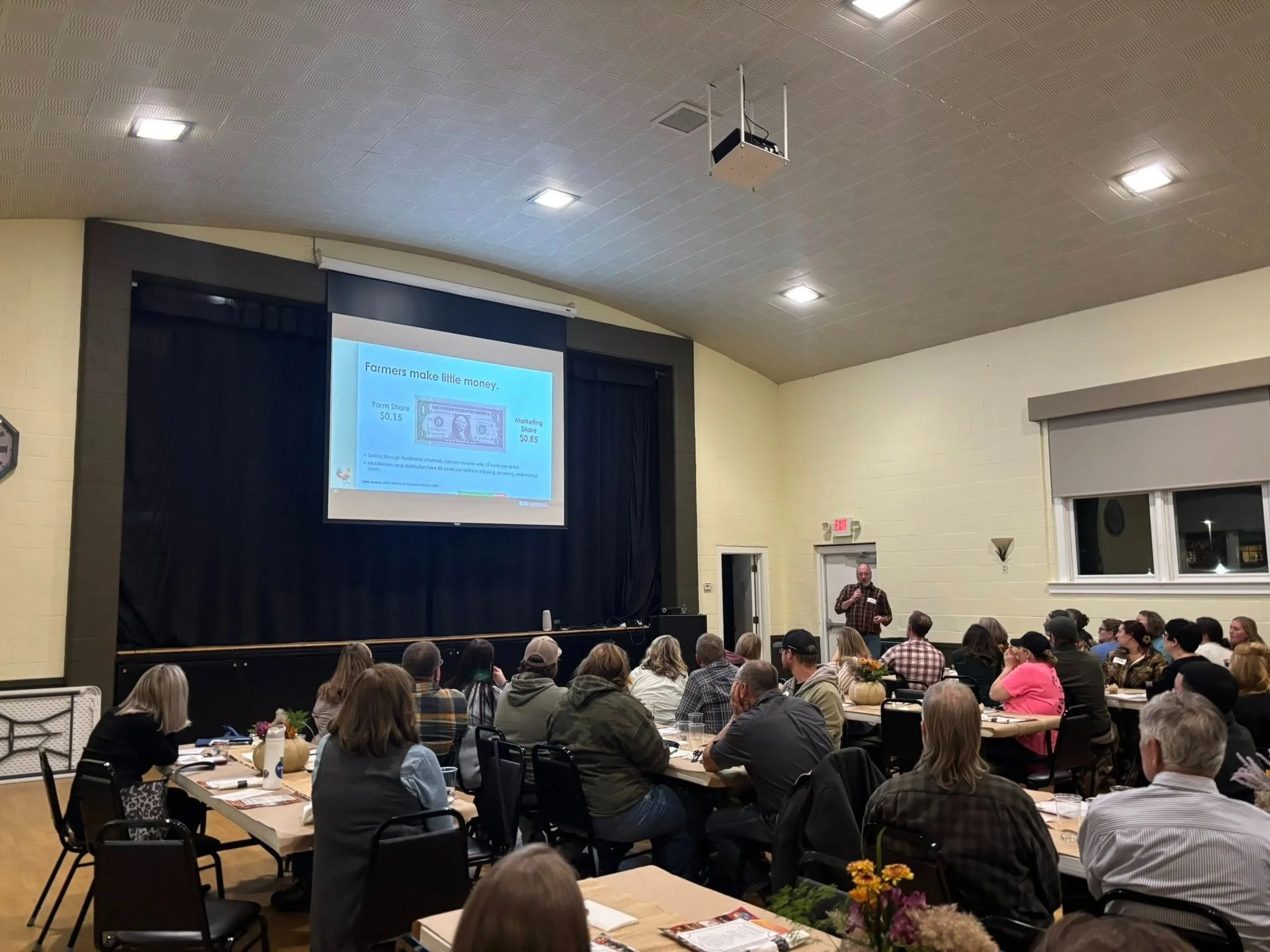
Farmers and community members gather in Hastings to discuss participation at the new farm stop.
MARK: How many farmers do you have signed up to participate as of right now, and how many do you think you need to have before you open?
ALLISON: We’re still in the early stages of vendor and farmer recruitment, so we do not have a final number at this point. However, the response and interest so far have been very encouraging. Our goal would be to launch with approximately 20-30 participating farmers, food producers, and vendors, with continued growth throughout the first year of operation as the market establishes itself and more producers come on board. We are focused not only on the number of vendors, but also on creating a diverse product mix that reflects the strengths of our regional food system and provides customers with a strong year-round local shopping experience.
MARK: What’s the food scene like in Hastings right now? What kinds of options do people have when it comes to groceries, and especially produce?
ALLISON: Hastings has a strong and supportive small-business and restaurant community, but like many rural communities, access to fresh, local, and specialty food options can still be limited, especially for year-round produce and healthier grab-and-go choices. Right now, most grocery access comes through traditional grocery stores and larger regional retailers. We also have seasonal farmers markets and local producers throughout the area. There hasn’t been a centralized, year-round space focused specifically on connecting local farms, food producers, and consumers in one consistent location, though. That’s part of what Mill Street Market is designed to help address. We want to expand access to local produce, value-added products, and healthier food options, while also creating stronger connections between consumers and the people producing the food. The goal is not to replace what already exists, but to complement and strengthen the broader local food ecosystem in Hastings and the surrounding rural communities.
MARK: I know it’s still early in the process, but do you have a sense as to how much business Mill Street Market will have to do each day in order to cover overhead?
ALLISON: We are still refining projections as construction, vendor participation, and operational planning continue to evolve, but we do have operating targets that help guide our planning. Right now, our working goals are approximately 73 grocery shoppers per day spending an average of about $26 each, along with roughly 125 cafe customers per day spending an average of around $10 each. Together, those benchmarks help us model the level of consistent community engagement needed to support daily operations. That said, Mill Street Market was intentionally designed as a diversified model rather than relying on a single revenue stream. In addition to the Farm Stop Market & Cafe, the campus also includes childcare operations, kitchen and culinary programming, partnerships, rentals, and nonprofit-supported initiatives that all contribute to the overall sustainability of the project. We are approaching this as a long-term community investment with phased growth over time, not expecting everything to operate at full capacity immediately upon opening.
MARK: It might be a bit early to have this conversation too, Bonnie, as your farm stop isn’t open yet, but what would you say to other community foundation directors who might be considering an investment in a farm stop?
BONNIE: It might be too early. And, as they say, if you’ve seen one community foundation, you see one community foundation. Each of our communities is different, with layers of relationships, local will, and personality. In our field, we watch each other to see if the successes are replicable in our own areas, though. So, be on the lookout for inquiries!
MARK: I’m curious about how information travels through the community foundation ecosystem. Do you have a national association, regional events, etc? I’m just curious as to how people in the community foundation world might hear about what you’re doing in Hastings.
BONNIE: We are part of the Council on Foundations (a national grantmakers association), CF Leads (a national community foundation association), and the Council of Michigan Foundations. We have many touchpoints, and often share successes to help others make long lasting impacts in their places.
MARK: I can see this being done in a few different ways from the perspective of a community foundation. In your case, it’s not that someone came to you with a plan, which you then decided to invest in. As we’ve discussed, the Barry Community Foundation will essentially own this project, hiring the managers, etc. Can you talk about why you decided to structure it in this way?
BONNIE: The foundation became the driver for the market and daycare due to the fact that we owned the property on which the housing project is being constructed. We have a plan to “off-load” Mill Street Market dependence on the foundation in 3-5 years. By incubating the project in this way, we believe that we are setting the work and its infrastructure up for long-term success.
MARK: Do you have a sense as to what that hand-off might look like with regard to the farm stop? Have you already figured out who will own it, once the foundation steps away?
BONNIE: Allison has done a great job of maneuvering this. There will be a for-profit entity and a non-profit entity.
ALLISON: We intentionally designed Mill Street Market to operate through both a non-profit and a mission-driven for-profit structure. That dual-entity model allows us to balance community impact with long-term operational sustainability. The non-profit side, Mill Street Opportunity Alliance, focuses on programming, education, food access initiatives, entrepreneurship support, and community impact work. The for-profit entity, Mill Street Market Farm Stop & Cafe, L3C, operates the retail and cafe components of the business. So, rather than the Foundation “owning” and operating Mill Street Market long-term, the goal has always been to build a sustainable operating structure that can stand on its own while still aligning closely with the broader community mission and non-profit initiatives across the campus.
MARK: Most farm stops are run by the individuals who start them. This is a little different, in that you, through the foundation, started the farm stop, and then hired Allison to run the operation. Can you talk about what you were looking for in a manager?
BONNIE: The board of the “Food Access Hub” – which was an earlier version of what would evolve into the Mill Street Market – worked diligently with New Venture Advisors to find the right person with the right skill sets. They needed to have experience in food, markets, and daycare with creativity, organization, and passion for the work. We found Allison at one of our events, and strongly encouraged her to apply. We published on LinkedIn, Indeed and through our local networks, ending up with about 20 applicants. Allison rose to the top very quickly, and, to our delight, she has been an amazing addition to our project.
MARK: So, Allison, you’ve got a lot on your plate. You’re not just going to be running the farm stop, but all three of the components that are operating within this building. I assume that means you’re going to need to rely quite a bit on other members of your staff. You’ve mentioned that Anne Ellis is going to be managing day-to-day farm stop operations. Can you talk a bit about staffing in general? How’s all of this going to work?
ALLISON: Absolutely, there is no way a project of this scale works without a strong leadership team in place. From the beginning, the goal has been to build Mill Street Market so that each core area has dedicated leadership and operational oversight. We are structuring the campus around key management positions, including a Farm Stop Market & Cafe Manager, a Childcare Director, and a Kitchen & Culinary Education Manager. Each of those individuals will oversee the day-to-day operations, staffing, programming, and growth within their respective areas. My role will be more focused on executive leadership, partnerships, fundraising, strategic development, and ensuring all of the components remain aligned with the overall mission and vision of the campus. The success of the project really depends on empowering experienced leaders within each operational area and building a collaborative team culture across the entire campus.
MARK: I’m curious, Allison, what you’re doing to get the word out about the Mill Street Market and what it is. I imagine, given the fundraising activities that Bonnie has talked about, most people in the community know what’s happening, but I’m curious as to how you’ve been communicating with folks, or how you plan to.
ALLISON: A big part of our work right now is continuing to educate the community about what Mill Street Market actually is, because it’s more than just a market or a single business. It’s a community-centered campus that brings together local food access, childcare, entrepreneurship, culinary education, and community partnerships under one roof. We’ve been communicating through a combination of community meetings, fundraising campaigns, social media, newsletters, local media coverage, presentations to community groups, and one-on-one conversations with residents, businesses, and potential partners. The fundraising efforts have definitely helped increase visibility and awareness, but we still see ongoing education and storytelling as incredibly important. As construction progresses and we get closer to opening, communication will continue to ramp up with more behind-the-scenes updates, vendor spotlights, partnership announcements, community events, and opportunities for people to engage directly with the project. We want people to feel connected to the process and understand that this is something being built with the community, not just for the community.
MARK: What advice do you have for folks out there, Bonnie, who are thinking about reaching out to their local community foundations to ask whether they’d consider investing in a farm stop?
BONNIE: Build a case statement about why it has to happen. What’s the mission of your community foundation? How would their investment assist in meeting the mission? Also, what’s the community's will? How many partners can you demonstrate have signed on to support this? I would also suggest that you find a local farmer or producer who is willing to be an ambassador for the conversation with the leadership of your foundation. Be able to articulate what the problem is that you’re trying to solve.
MARK: This is also a unique project in that you’re building this from the ground up. I know it’s difficult, as you have several distinct projects operating within the same footprint, but I’m wondering if you can give us an idea of what you think the farm stop component alone will cost?
BONNIE: Facility development accounts for the largest part of the total development cost. The entire construction scope, including the building edifice, interior space, childcare expansion areas, and outdoor space, is budgeted at approximately $7 million. The total build cost for the market is just under $900,000.
MARK: Can either of you give us a sense, at a high level, how that $900K breaks down?
ALLISON: I tend to look at the project more holistically because all of the components are interconnected and designed to support one another operationally and financially. While the total construction scope for the market portion is just under $900,000, that number includes a combination of retail buildout, cafe space, infrastructure, fixtures, refrigeration, and operational systems needed to support a year-round food operation. To date, we have raised approximately $5.7 million toward the overall capital project, equipment, startup needs, and initial years of operation across the campus. One thing people often underestimate is the cost of commercial food infrastructure. The Farm Stop Market, Cafe, and kitchen equipment alone account for roughly $800,000 in costs, including refrigeration, freezers, prep equipment, cafe operations, aggregation infrastructure, storage systems, and commercial kitchen needs. Because we are building this from the ground up, we have intentionally focused on creating infrastructure that supports not only retail operations but also food aggregation, entrepreneurship, culinary education, and long-term community use.
MARK: A year from now, what do you hope other community foundation directors will be asking you about this project, Bonnie?
BONNIE: “Can you share how this might work for our community?”
MARK: And, Allison, when you close your eyes and imagine a successful day at Mill Street Market, what does it look like? What are you seeing?
ALLISON: When I picture a successful day at Mill Street Market, I see community. I see people shopping for local products and discovering something new from a farmer or food entrepreneur they may not have met otherwise. I see neighbors sitting in the cafe having coffee and conversations. I see food entrepreneurs experimenting, creating, and growing their businesses inside the incubator kitchen. I see high school Culinary Arts students learning the trade through hands-on experiences, and children laughing, learning, and growing in Little Sprouts Childcare. But, more than anything, I see people coming together, across generations and backgrounds, to build a stronger local community centered around food, connection, opportunity, and shared investment in one another. That’s really the mission of Mill Street Market — creating a place where local food, learning, entrepreneurship, and community all intersect.
Visit the Mill Street Market website, https://www.millstreetmarket.org/. Please leave a comment below!