Radish Farm Stop Approaches Launch in Minneapolis
April 2026
Author: Mark Maynard
MARK Maynard: I just saw that you’ve secured a space for Radish. Congratulations. What can you tell us about the building that you’ve found?
LILY Gross: We’reon the corner of 54th and Penn Avenue, in southwest Minneapolis. We're about four blocks south of Lake Harriet, which is at the bottom of the chain of lakes. It's a freestanding building, with 2,500 square feet on the main floor, and another 800 square feet in the basement. Along the north side, we have a driveway, which will help make producer deliveries easier. And we also have solar panels on the roof.
MARK: What neighborhood are you in?
LILY: We’re in the Lynnhurst neighborhood, by just a hair. To the northwest of us is the Fulton neighborhood. To the South is the Armatage neighborhood. And then we also have a neighborhood called Kenny that's off to the southeast.
MARK: That sounds like an ideal location, right at the intersection of four different neighborhoods, and walking distance to the lake. Assuming you were considering other locations, can you talk a little bit about how you made the final decision?
LILY: I looked for a location for six months to a year, depending on how you look at it. In terms of the building itself, I had very specific criteria that I listed out in a spreadsheet to help guide the search. I really wanted the location to be in what we, here in the Twin Cities, call a “trolley stop” corner. There used to be a trolley system here, and we still have these really great sort of commercially-zoned areas that came out of that, all built around the former stops. And so there are these small neighborhood hubs where there might be 5 to 10 businesses, often locally owned. It creates a community gathering space. I wanted to find a space in one of those areas. I wanted a place that people could walk to on the weekends, that had complimentary businesses nearby. I wanted a busy road with commuter traffic, but not so busy that it made it unpleasant to sit outside.
MARK: You mentioned that you were just a few blocks from Lake Harriet, which I assume also draws people to the area.
LILY: There are a lot of people biking and walking around as a result of the proximity to the lake. We’re hoping they can just hop off the lake, and head down to Radish to grab something. We're also close to Minnehaha Creek, which is another place where a lot of people like to engage in outdoor activities. It’ll be hard for those people to miss the building. We're on a corner, so it’s really easy for people to notice us as they come by. We have a patio outside, and nearly floor-to-ceiling windows on both the south and west sides of the building.
MARK: What’s the status of the project right now? What are you working on?
LILY: This weekend, my partner Chris and I were at the store nearly all day, both Saturday and Sunday. On Sunday, we painted the entryway door. We painted the sign, and put in the Radish Farm Stop acrylic sign in the window. It looks a lot perkier now. People were driving by, yelling out their windows about how excited they are to have us here, and asking when we're opening. Chris joked, "How can we get work done when everyone wants to talk?" It's been really great, and I'm excited for word to continue to spread. Inside the store, we have the coffee counter framed up, but the finishes won't go on until mid to late April. Plumbing is nearly done. Electrical is happening today. Some equipment will arrive on April 13th, and the refrigeration should get put in on the 16th. It mostly just looks like a torn up construction zone right now, but all of the main elements have been put in place, so it should begin to come together quickly.
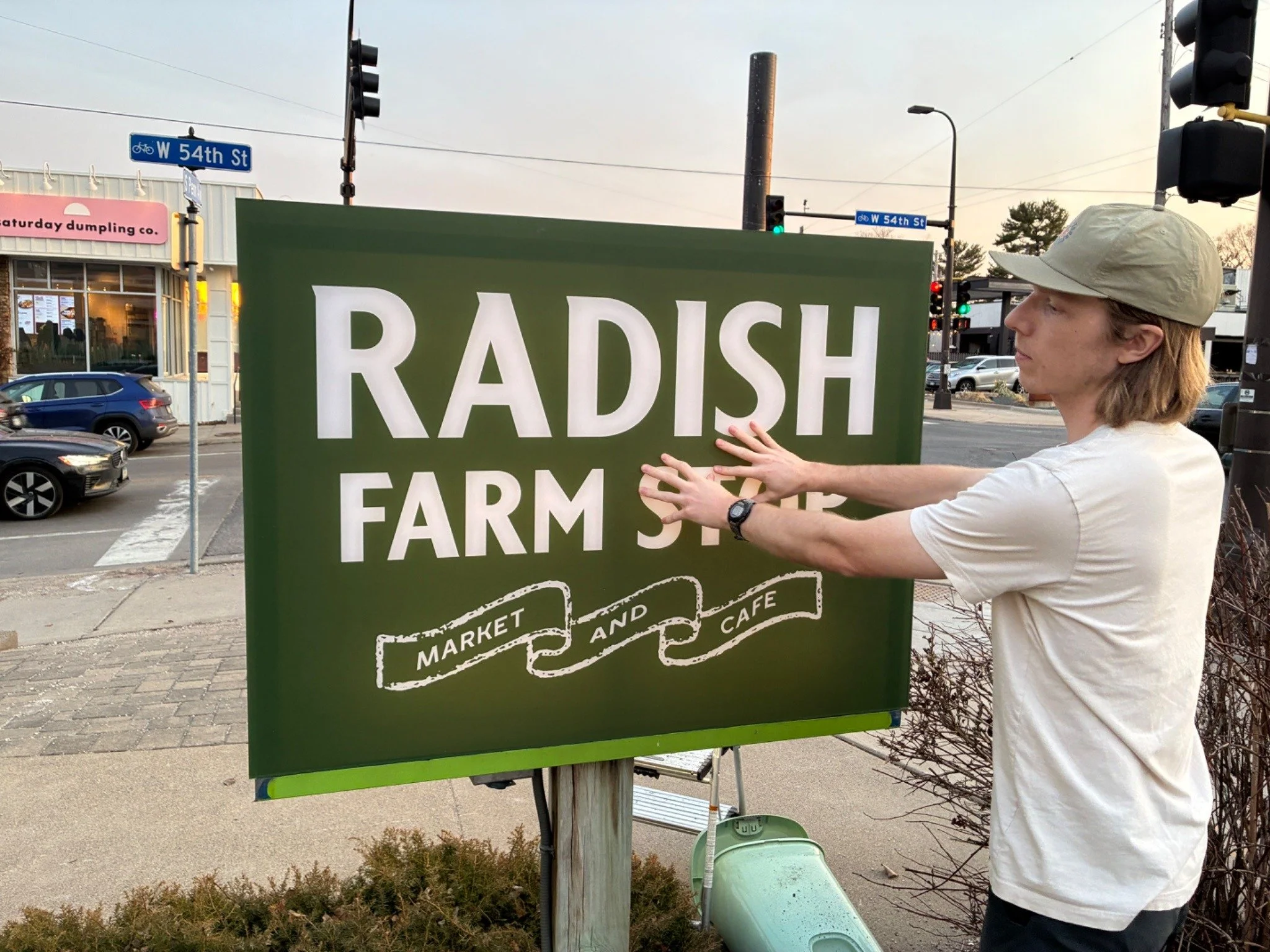
Chris, Lily’s boyfriend, testing out the new sign.
MARK: You mentioned trolley stop intersections earlier, and that you were looking into a number of these areas. How many of these former trolley stop, neighborhood-centric, commercial center areas were you considering before narrowing it down to this one?
LILY: There were probably a dozen trolley stop locations that we explored. In the end, I'd say there were probably four or five neighborhoods that we were seriously considering. The thing that's great about Minneapolis is that it's a lovely place, and there are a lot of good neighborhoods to pick from. But that can make it hard to decide. It came down to the intersection of a few things. We had to find a commercial building that was available, the right size, and well maintained. It can be hard to find a solid commercial building that's available. A lot of buildings can just sit on the market forever. And we didn’t have the budget to take on a really complicated project. This property had been listed fairly recently, and worked perfectly in terms of all of the criteria we were looking at. The neighborhood also had the community feel we wanted.
MARK: Did you do any kind of demographic analysis, once you’d narrowed your search down to those final few neighborhoods?
LILY: Before closing, we double checked the demographic data. We looked at public census data, and things like that. So we had a sense of the average age in the neighborhood, family size, income levels – the sort of the typical criteria that you'd want to see. It all lined up nearly perfectly with what we wanted.
MARK: I know you’ve been out, talking with farmers for a while now. I’ve heard through the grapevine that the response has been incredibly positive.
LILY: Yesterday, I went through all the applications that we've received so far. Similar to Argus, once a month I review applications in a group, all at once. And, so, when I started reviewing applications yesterday, I had already approved around 50 producers to sell through the store. After approvals yesterday, we are sitting at around 80 producers. We’re still actively talking to a few people, as we do have some supply gaps that still need to be filled, but have worked to keep the number of farms and meat producers limited so they are able to sell a worthwhile volume through Radish. We have a higher ratio of shelf stable grocery in the producer list.
MARK: It makes sense to start with a manageable number of producers. How did you determine what that number should be at the outset?
LILY: I know that Argus started with 40 producers, and felt perhaps a bit light on supply in a few areas so I thought, “60-80 seems like a manageable number to start with.” I know that, if we bring on more producers than we can reasonably manage, it will negatively affect their experience, and we don’t want that. I've worked really hard to keep the produce side of things manageable, while also making sure that we have enough to deliver a robust shopping experience. In time, though, I’m sure we can scale up to work with many more producers than we're starting out with.
MARK: So, the question is, how to deliver the full bounty of the region, but in a way that’s manageable at the outset. So you have to be careful when considering the farms that you’re starting with, right?
LILY: Right. For example, we had about four different micro greens producers that had applied, and I concluded there's probably about one, maybe two, that we can work with right now. So, I had to reach out to the others, and say, “We just don't have the capacity for you at this point.” And there are a lot of other similar examples. Maybe there’s a grocery item that isn't very critical at this time, but I know that, once we get our feet under us, we can bring them in. So there were maybe about 15 to 20 people that I emailed yesterday. I told them, “We just won't have the capacity right off the bat to manage all these relationships, but let's stay in touch, because I do anticipate, as we onboard the first batch, with time, we'll be able to bring you on.”
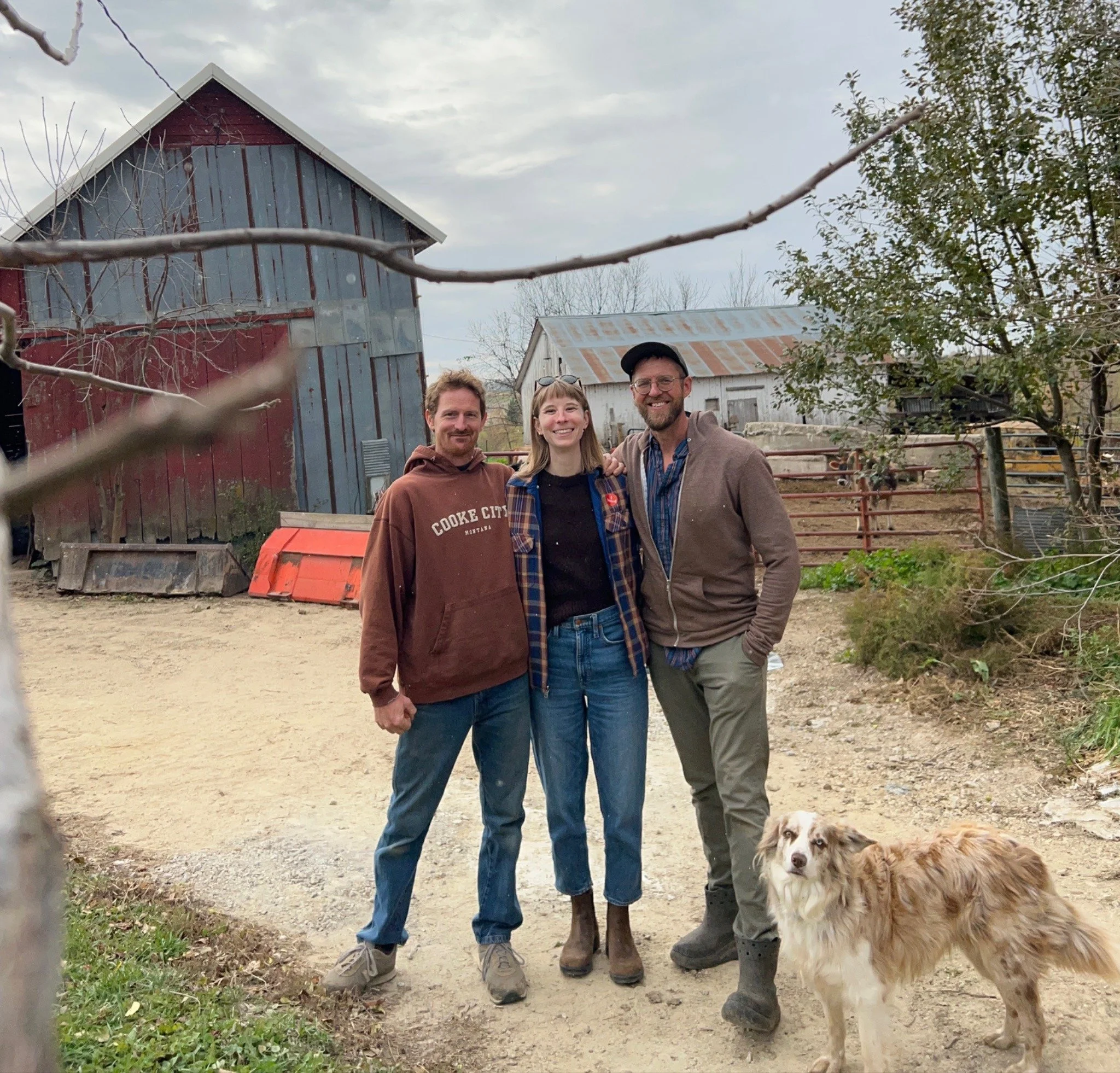
Lily with Joe (left) and Bill (right) of Heartbeet Farms
MARK: Of the 80 producers that you’ve signed on, how many are small farms that will be delivering produce?
LILY: On the produce front, we have 12 farms right now. Two are what I would say are the core of our produce program right now. They grow the most varieties of vegetables, and they’ve sold at co-ops for quite a while. So they have a lot of retail experience. So I identified that we really needed to have a couple of those farms to act as our foundation. And then we have a farm that specializes more in herbs and leafy greens. And so they'll be able to fill in when it comes to specialty type produce. We have another who does a wide range of things, including flowers and fruit. And they’re going to be really good at plugging in when there are supply gaps. And it’s still in the early stages, but we’re trying to work with the local farmers market, seeing if they might be able to act as an aggregator in some way.
MARK: I’m curious if you could say more about farm recruitment. How did you find your first producers? Did you go through existing networks, cold outreach, word of mouth? And what does your application ask for?
LILY: For our first producers, it was a combination of relationships I’d already built, the support of existing networks, and quite a bit of cold calling and emailing. I think I’ve probably explained what a farm stop is, and shared Radish’s story over 200 times. Our application asks typical housekeeping questions, and then asks producers to share their story, certifications, and growing practices, so, right off the bat, we have a foundation of understanding of each farm. Here’s the link to our application, if you’d like to take a look!
MARK: When you're evaluating farms, how do you assess whether they'll be reliable partners?
LILY: So much of this is about relationships. Many of the producers we’re working with I already knew, knew of, or had shared connections with. So, I had a sense of who was reliable, kind, good to work with, and had a shared mission. Beyond that, the application does a good job of helping to self-select. There were many producers who seemed interested, but just wouldn’t take the time to fill out the application, so, in that way, they were self-selected, or perhaps it just isn’t a fit for them at this moment, but it could change down the road.
MARK: You mentioned that there were still a few gaps that needed filling.
LILY: I'm thinking constantly about fruit. It is pretty challenging to grow – especially berries – in Minnesota. There are fruit vendors, but they’re often selling everything that they have themselves, from their farms. Or maybe they have the capacity, but just haven't explored retail avenues given the complexity that’s involved when you're selling through a typical wholesale avenue. So, I see a need to build out more relationships in that area. That's been something that I’ve actively been working on.
MARK: I imagine there will always be gaps, at least at first. I know, when Argus opened, for instance, they didn’t have a local yogurt supplier. But things evolve over time. Once you open up, opportunities will present themselves. Farmers, seeing that there’s a need, will find a way to make it happen.
LILY: Yes, I really hope that we’ll be able to help encourage the introduction of more businesses, and produce offerings by providing this consistent sales avenue.
MARK: I wanted to ask how receptive farmers were to the consignment model. Before we get to that, though, I really like how, on your website, you frame it. There are three simple phrases. “Farmers own it.” “Farmers price it.” “Farmers keep it.” I just think that’s a beautiful, elegant, very simple way to describe the model. And I was wondering if you're ready to have people in the farm stop movement steal that framing. Every farm stop addresses it in a different way, and they’re all great, but I just really found this to be a nice distillation of the farm stop concept. Could you talk a little bit about how you arrived at it?
LILY: It’s really nice to hear that you like it. People are welcome to steal any and everything that I’ve created, as long as I can reuse whatever their improved version of it is. I came up with that framing with a very good friend, Sam, who has been helping with the website. He's a copywriter as his full-time job, and we have been meeting on a monthly basis. It has been holding me accountable to keeping the website fresh, and he has a much better eye for design than I do. So, we took a first stab at the website, and then we were talking one night... Honestly, he came over for dinner and we had plans to work on the website. And then, after we'd finished a bottle of wine, we were just talking, hanging out, catching up. We didn't get much website work done that night. But, we talked about feeling frustrated with the website. I felt like, for the typical person who looked at it you'd go, "Oh, interesting. It looks, you know, like they're doing some kind of farmers market type of thing." But it wasn't really clear how it was different from maybe a co-op, or another, sort of Fresh Thyme or natural foods grocery store. To get to “the mission” part of the website, you had to navigate to a different page, and read deeply into it to understand what was going on. So I was sort of banging my head against the wall, thinking about how to distill this. “How do we create something where people can look at the page and pretty quickly understand what's unique about the store?” In this day and age, with our shortened attention spans, we needed to make it really digestible. So, we had that kind of drunken conversation, and got back together a couple weeks later at a coffee shop. That simplified copy was something that Sam came up with as we were spitballing how we could simply describe what made Radish different.
MARK: Was there any apprehension at all on the part of farmers about the farm stop consignment model? If so, how did you address it?
LILY: Of course there is apprehension with a new model, and a model where you are completely trusting someone to take care of the product you created. I found that talking in person or over the phone with producers helped a lot. I could walk them through the vision for the store, and the reasons we chose the consignment avenue. At its core, the way I see it is that consignment is a way to foster more of a partnership. Wholesale is transactional. With consignment you are sharing in that risk, and also allowing producers to experiment a bit more with their offerings. It’s more transparent for customers. They know exactly how much producers get paid when they check out.
MARK: I’m curious as to your non-produce suppliers. Were you able to find a local coffee roaster to work with? Are you working with multiple bakeries? How about meat suppliers?
LILY: We will be working with Backstory Coffee for our cafe program. We will also be working with several other local roasters who will sell through the market. We will be working with several local bakeries as well, similar to Argus, and about 10 different meat and fish suppliers.
MARK: Knowing that you grew up in Ann Arbor, and that you’re relatively young, I’m guessing that you were probably a teen when Argus opened their first store. I'm just curious when you had your first interaction with Argus, and whether you had any sense at all, in that moment, that, one day, you might be setting out on this path, and opening a farm stop of your own..
LILY: I'm really glad that you asked that. I remember it like it was yesterday. When Argus first opened, I was 18, and about to head off to college. I remember that I was at the Ann Arbor Farmers Market with a good friend who was on the tennis team with me. We loved going to farmers markets together. Even at that age, I knew that I wanted a career in sustainable food systems work. And this friend mentioned to me, while we were shopping, “Hey, I heard that there's this really cool grocery store that's opening just up the road.” So we decided to check it out after the farmers market. I think it was Argus's grand opening. We wandered in, and were just completely taken by this really abundant, bountiful grocery store which was filled to the brim with local produce. And the other thing that struck me was the variety. I had a pretty solid sense, even then, of the various produce options, what they looked like, and how to cook them. And there I was, looking at four different kinds of garlic. I didn't know that more than one kind could possibly exist. And I was just like, “What is this amazing place?”
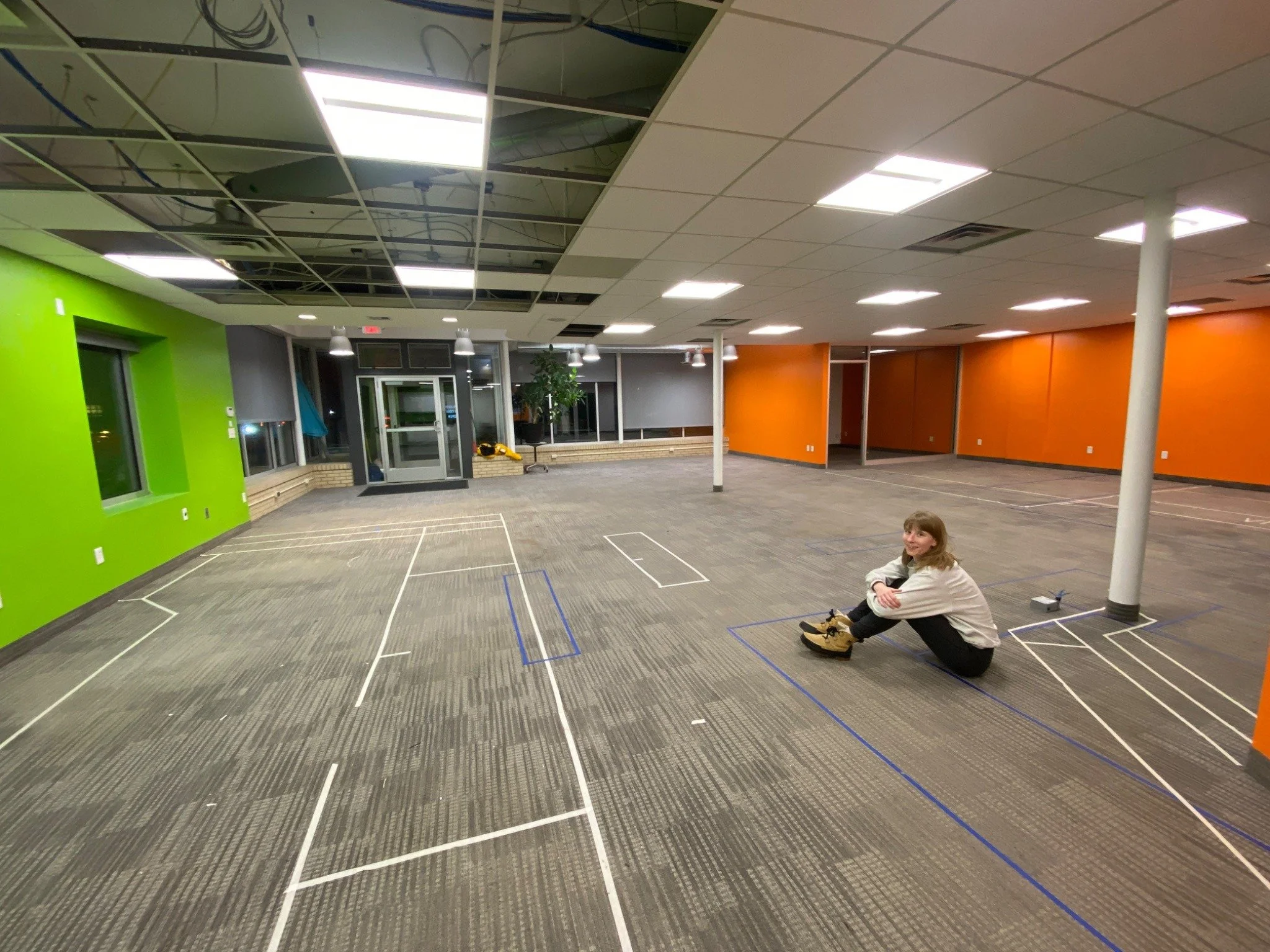
Lily at Radish Farm Stop surrounded by the taped out floor plan
MARK: And at what point did you start talking with Bill and Kathy, and the folks at Argus?
LILY: You know, I would come back from college in the summers, and would say, "Hey, are you hiring?" And they'd say, "We're at capacity, but try us again next year." And so, I would say that, for a long time, I had Argus tucked away in the back of my head as a place where, maybe someday, I'd try to get a job, or something like that. But I quickly got pulled into my initial career, which was working to create positive food system change. And, when that ended up looking a little more corporate, I started thinking more about Argus. As we were emerging from the pandemic, I think a lot of people were really reflecting on what they were doing, and how they were contributing, or what kind of mark they wanted to leave on the world. I was working at a food marketing agency at the time. Honestly, I thought again about getting a job at Argus, but then I thought, “It'll be really hard to get a job at Argus. It's so competitive. What if I created something like Argus in Minneapolis instead?”
MARK: (Laughs) That's funny. I haven't heard that before. It’s great. You set out to start a farm stop because you didn’t think you could get a job at Argus. That's awesome…
LILY: Well, it was a process. Before deciding to open a farm stop, back when I was working at the marketing agency, I first thought about creating some sort of app that would help people… guide them in the grocery store… and help guide their purchasing decisions, helping them to be more thoughtful about the food decisions they're making.
MARK: But then you decided to open a farm stop in Minneapolis. Before doing that, though, you first set out to first get experience in grocery, working in a co-op produce department, building relationships with local farmers.
LILY: I reached out to Kathy and I said, "Hey, I really want to explore what it would take to open something like this in the Twin Cities. What do I need to do?" And she said, "Well, let me connect you with Katie Barr. She's producing this book that'll be a good first step. Then, if you're really serious about this, you need to get a job in grocery." I hadn't worked in grocery before, and so that also seemed like a logical step to know whether or not I actually liked that, or was any good at working in a produce department.
MARK: So you applied at your local co-op?
LILY: Yeah. Originally, I was just going to work there at night, stocking shelves. I was going to keep my agency job, and just work like seven days a week. But then I realized that there were specific roles at the co-op that might give me more relevant experience. There was a posting for an assistant produce manager position, and it just felt like a perfect fit. This was one of those times, several have happened over the last four years, where things have just clicked into place in a way that feels really lucky. When I decided I wanted to take this new path, it just so happened that there was this sort of perfect role available, and I took it. I worked there for several years and was able to really organically learn about the process of operating a grocery department. I would say, still at that time, the thought of opening a farm stop was a far off dream. I didn't know if it was actually going to happen until about a year and a half ago.
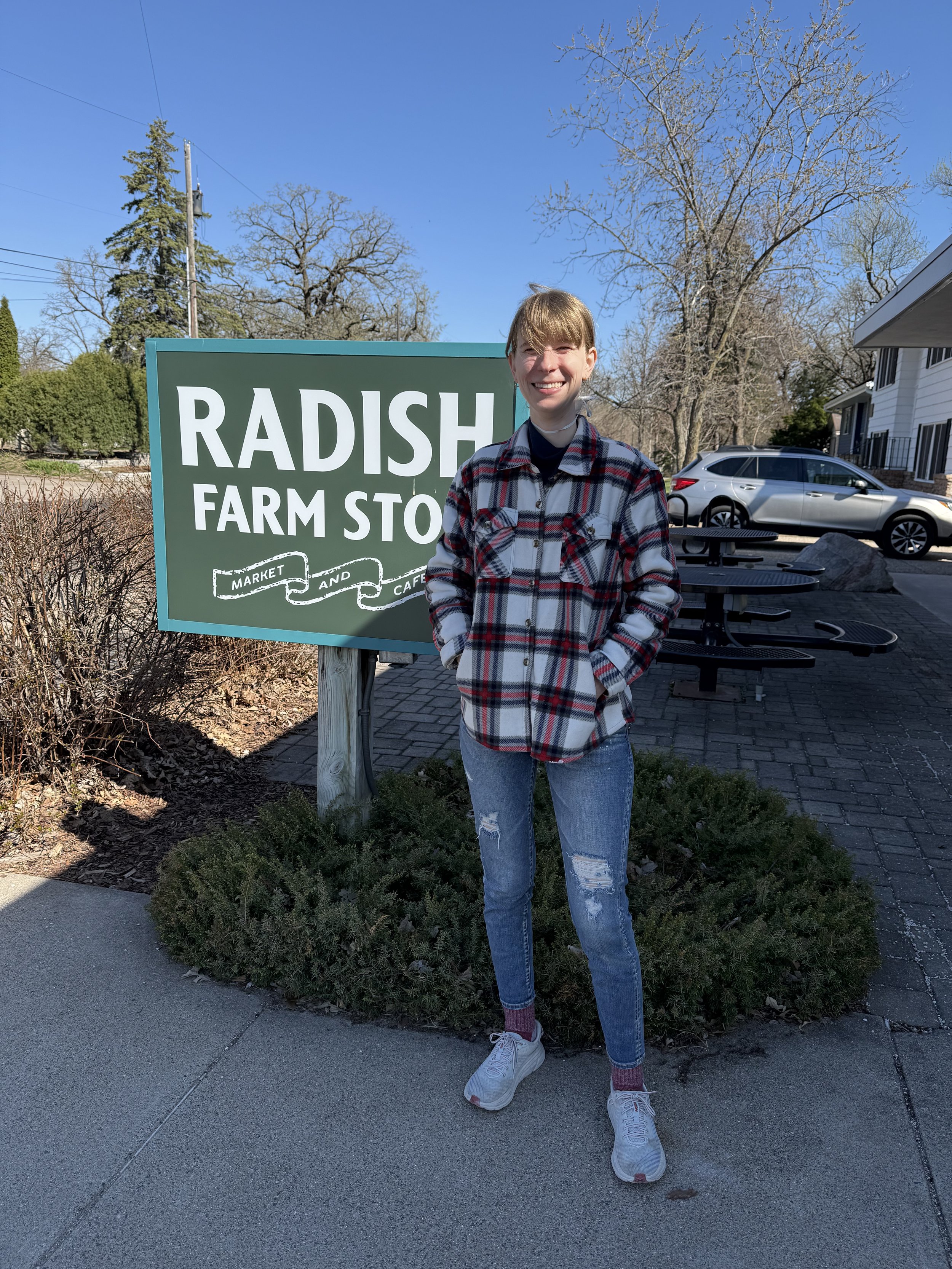
Lily in painting clothes outside Radish Farm Stop
MARK: I'm curious to know about your experience at the co-op, and whether, as a result of that job, your thoughts evolved at all about the farm stop model. For instance, working in a more traditional grocery setting, I’m just curious if you ever thought, "Oh, so maybe this is the reason more people in this industry don’t use consignment models”, or “Now I can see why a produce department would rather not work with dozens of individual farmers.” Or did everything you experienced just reinforce your belief in the farm stop model?
LILY: That’s a great question. Something that I really appreciated about my experience at Seward was that I was given a lot of leeway in how I managed the department. After I was promoted from assistant manager to produce department manager, I was able to make a lot of decisions around what farms we were prioritizing and sourcing from. And so there would be – especially on the cusp of seasons – times where we could go, “Oh, let's just get this from California. It's easier.” I worked really hard to train our team, so that our buyers felt really comfortable working on those shoulder seasons, and bringing in products. I think, with that, there's a lot of good that comes with the flexibility that I experienced at the co-op I worked at, but that also creates a vulnerability. If there's a different produce manager, who takes things over, and maybe doesn't prioritize that local mission quite as much, then that changes the purchasing behavior. That's something to me that's really powerful about farm stops. At your core, as a farm stop, you're beholden to sourcing 100% local products. So there's not as much of that vulnerability. There’s not a chance that, if this one person is buying that day, they might make a decision that doesn't directly support our local food system. There might be better ways that you can do things, but, no matter what, you're supporting local farms. So that's the first layer.
I should add that I’m really proud of the work that I did over the course of my time at Seward. I was able to really improve our produce department, and especially our local sourcing program. That made it really hard to leave. I’d put a lot into creating a team that was well trained and building systems together that allowed us to increase the volume of what we were doing. Radish won’t be doing the same volume as the produce department that I managed. So, on one hand, I’m giving up some purchasing power. But, with Radish, everything is local, and I’m getting to build it from the ground up.
MARK: I can see it being a difficult decision. Here you helped build a wholesale local buying program, where you had agency to actually create positive change for the farms, and do it at scale. But, at Radish, as you said, every single sale is going to positively impact a local farm. And the margins are better for those farms. One last thing on the subject of co-ops. Did you consider starting Radish as one?
LILY: I think that there are pros and cons to all organizational structures, but there are several reasons I decided not to go the co-op direction. The main one being really that it generally takes about 10 years from ideation to opening if you're going to launch a co-op. And we're losing farms every season. This is too urgent of an issue.
MARK: On the fundraising side of things, you and I have talked in the past about the difficulty you encountered when it came to securing grant funding. Thankfully, you were able to borrow money through the city, and you received a low interest loan through a local economic development group in Minneapolis. But, in large part, you were able to make Radish a reality because you had people in your personal network who were in a position to assist with startup costs. Can you talk a bit about your experience in fundraising?
LILY: I tried everything: grants, small business loans, etc. A couple of years ago my parents said to me: “It’s clear that this is really your dream, Lily, and you’ve already put so much toward trying to make this a reality. If you need us to help you realize it, we’ll pitch in.” Their loan allowed me to move from dreaming, to planning: I began looking for a location, applying for loans to round out some of their support, finalizing the business plan, etc. As I look back, I feel very clear eyed about how critical that sort of support is, unless you have a non-profit already established, or enough of your own capital. I am so grateful to have so many people in my life that believe in me.
MARK: While we’re on the subject of finances, what can you tell us about your projections? How much are you hoping to make it year one? How much are you hoping to pay out to local farmers? And, at what point, are you hoping to break even?
LILY: I’m hoping in our first year we’ll see about $1.2 Million in sales, about half of that will come from the cafe. So, if there’s $600,000 in market sales, $420,000 is going back to farms, as we’re doing a 70/30 split with farms. I hope it’s more than that, and this turns out to be a conservative estimate.
MARK: I see that you’re starting to get some local press. I heard your interview on Minnesota Public Radio, and I read the piece that Racket did. What’s the feedback been like?
LILY: I’ve been blown away by the response and it has just been really sweet and validating. To me, opening a store is kind of like you're throwing a party, and then you're waiting to see if people come. I feel like there's already so much excitement and support and enthusiasm, which is certainly motivating. Right after that Racket article came out, I would get producers just calling me out of the blue saying, "Hey, I just read about this store. Like let's chat. I want to learn more." Neighbors are sending us emails through the “contact us” page just expressing how excited they are that we're coming to the neighborhood. People are messaging pretty regularly on Instagram, just expressing how much this particular part of the Twin Cities needs something like this. For context, there used to be two coffee shops in our neighborhood, and both recently closed. One had a pipe burst, so it was forced to close due to the damages, and the other owner decided to do something else. So there's a lot of excitement about accessibility to local food, and being able to have a coffee shop community hub again.
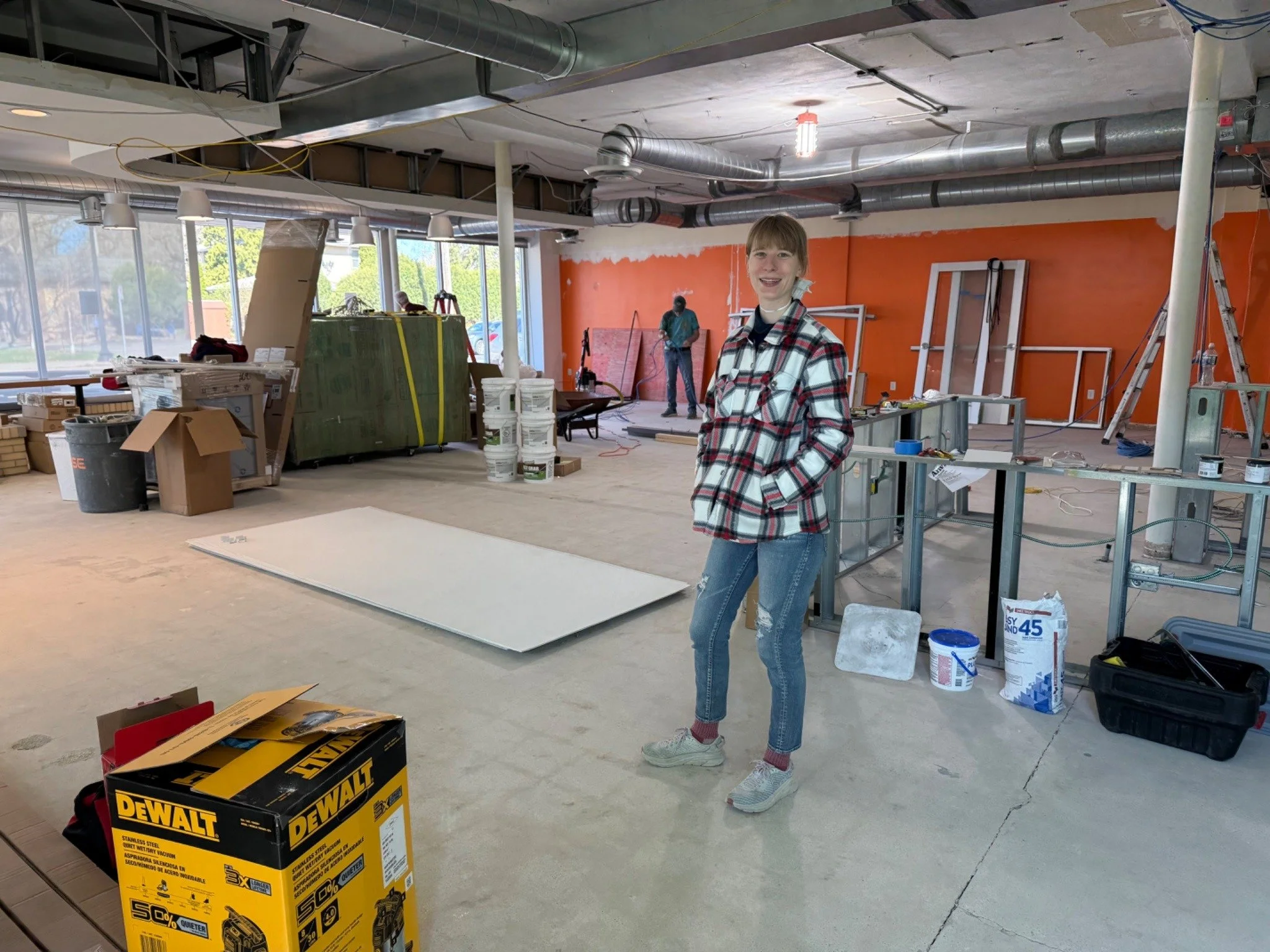
Work day at Radish Farm Stop
MARK: What's the environment there like for local food? You mentioned that the farmers market you're working with is relatively close. What's the grocery environment like at this intersection of these four neighborhoods? Are there other options for local food or would this be the only one other than the farmers market?
LILY: We have a couple co-ops that are fairly close, but you have to drive to them. They're like a 5 to 10 minute drive from where we are. Then there are a few locally owned grocery stores, like Kowalski's, and Lunds and Byerly's, that are both within about a mile or so from the store. But none of the stores are offering exclusively local products. In that way, I think that our businesses complement each other well.
We'll be a place where people can go and directly support local producers, and then, afterwards, they can fairly easily drive to another store and round out their shopping trip. Speaking of this, I should mention that everyone that I've crossed paths with here in the Twin Cities shares in the desire to focus on how we can uplift one another. For example, the produce manager at Kowalski's just donated the produce displays that we'll be using. They did a store reset, and didn't need them anymore. There are good things happening at all these places. At my old job, at Seward Co-op, they’ve reached out several times saying, "Hey, there's this random thing we're getting rid of. Do you want it?” And I've been getting ongoing advice. There’s a lot of goodwill, and I’m thinking a lot about how we can continue to support one another.
MARK: I'm also curious about the local farming situation there. I haven't looked at Minneapolis numbers specifically, but I suspect the number of small farms has decreased significantly over the last several decades, as is generally the case across the country. Do you know how much farmland has been lost within the greater Minneapolis area, and what kind of environment you're walking into in terms of small farm sustainability?
LILY: I actually presented this morning to a high school class so I have these numbers ready. In Minnesota, the median net farm income in 2024 was $21,964, which is the lowest this century. The other thing I have is this is a chart, which shows that, in 1965 or so, there were just over 125,000 farms in Minnesota. In 2020, there were less than 75,000. So that really speaks to this sort of consolidation.
MARK: One of my favorite things about this most recent Farm Stop National Conference was hearing that you’d gone out one evening with a group of other young people who are all in the process of starting farm stops. I liked the idea that a small cohort of folks is coming together. Can you talk about the information sharing within the farm stop community? I love that people can come to Argus for support, but I think there’s something really powerful about these budding informal support networks that are forming.
LILY: Yeah, that was a fun night. We all went out for dinner and then drinks after. Patrick [Randolph], who is opening a farm stop in Madison, and I have become really good friends over the course of the last several years. We met at the first Farm Stop National Conference, and pledged to each other that we were going to open our own farm stops. So we decided to create an accountability group. We’ve stayed in touch, and continued to check in on one another. Somehow we're both hard-nosed enough that we've continued on this path. Before dinner that night, at the conference, we were like, “Let's just invite everyone we possibly can to go out, and talk about our plans.” It happened organically, pulling in everyone we could that’s in the process of starting a farm stop.
MARK: I heard about this gathering from Travis [Robinson], who is hoping to open a farm stop in my home town of Lexington.
LILY: Travis has been really a joy to get to know. He emailed me a few weeks ago and asked if there was any information I could share around basket size or foot traffic projections, and I was like, “I'm just going to send you my entire spreadsheet of financial projections.” It's just been really fun to get to know everyone better, and support one another. I mean, I also think that Argus has done so much good by creating this sort of culture. Argus has been so helpful and generous with the support that they've given. It's created this culture where all of us are paying it forward. You know, I feel this responsibility because there are so many people that have helped make this happen for me that I'm like, "Yeah, steal the copy from my website, take a look at my financial projections, ask me for advice on equipment, etc." Like, I'll do whatever it takes to help. You want to make this easier for the next person because it's incredibly challenging to start a business.
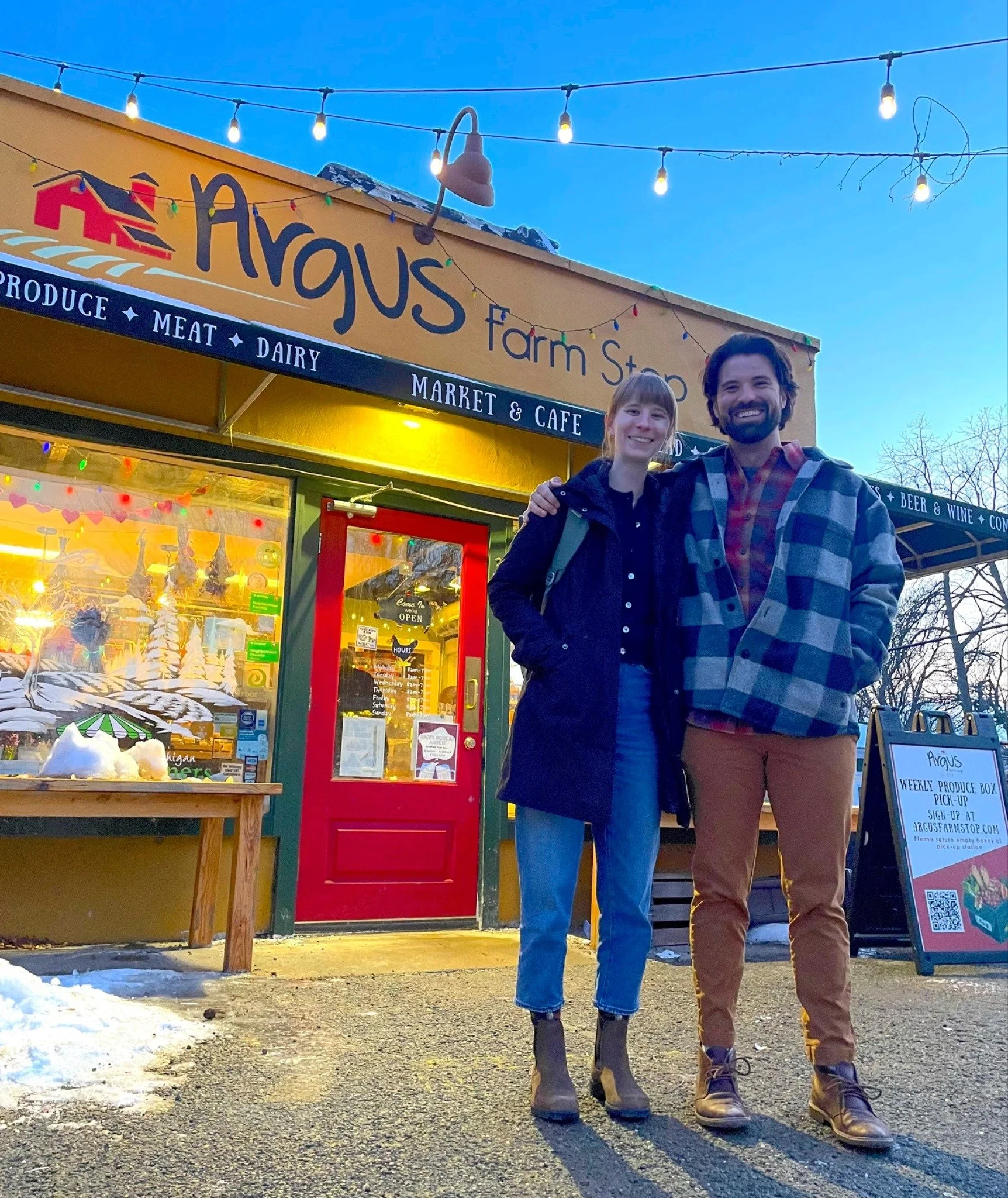
Lily & Patrick standing outside Argus at the most recent Farm Stop National Conference
MARK: What are you most excited to learn in year one?
LILY: I’m excited to learn from my team, from my community, and from all of the incredible producers we are working with. I’m not sure what it will be, but I know I’m going to continue to learn, and grow a lot.
MARK: Speaking of your team, I’d like to talk a bit about your hiring to date. I’m curious as to how many other people you’ve hired, and what specific jobs you’ve hired for. Do you, for instance, have a general manager, or will you be working in that role yourself?
LILY: My official title is Founder & General Manager, in large part because I think it’s important to be an active participant in store operations, I don’t want to just be tucked away in an office somewhere 24/7. Hanes, our Store Manager, will own all day-to-day operations, and the team will report directly to her, which frees me up to address some of the unexpected things that can come with running a new business. In total, we will be a team of 9 to start, including Hanes and me. The other positions are full-time or part-time Market and Cafe Clerk. The role is integral in the day-to-day operations of our market and specialty coffee bar. These are extremely varied positions, and our team members will be trained to handle most aspects of daily store operations across spaces.
MARK: If someone's reading this and thinking, “I want to do this in my city,” what's the first thing, in your opinion, that they should do?
LILY: In my opinion, they should do three things: 1. Find a job that will help prepare you to start a farm stop: manage at a grocery store, run a farm, work as a barista, etc. Take that first, smaller leap, before you leap into starting a business. 2. While you are doing that, make sure you really love acting in service of your community, working hard physical jobs, and you don’t mind doing messy things, like deep cleaning a produce fridge. 3. Talk with people about it: connect with people in your community that are already doing this important food systems work, ask them how you can help, offer this idea, and just be open to connecting with everyone about it. There will be some people who don’t understand what you’re trying to create, and that’s OK. Surround yourself with people who help you feel less alone in this journey, and bring ideas and feedback to the process. Make sure it is a reflection of your community. If you’re getting beer at 9:00 PM with a stranger turned friend, and picking their brain on what farmers they know, you’re probably in the right place.
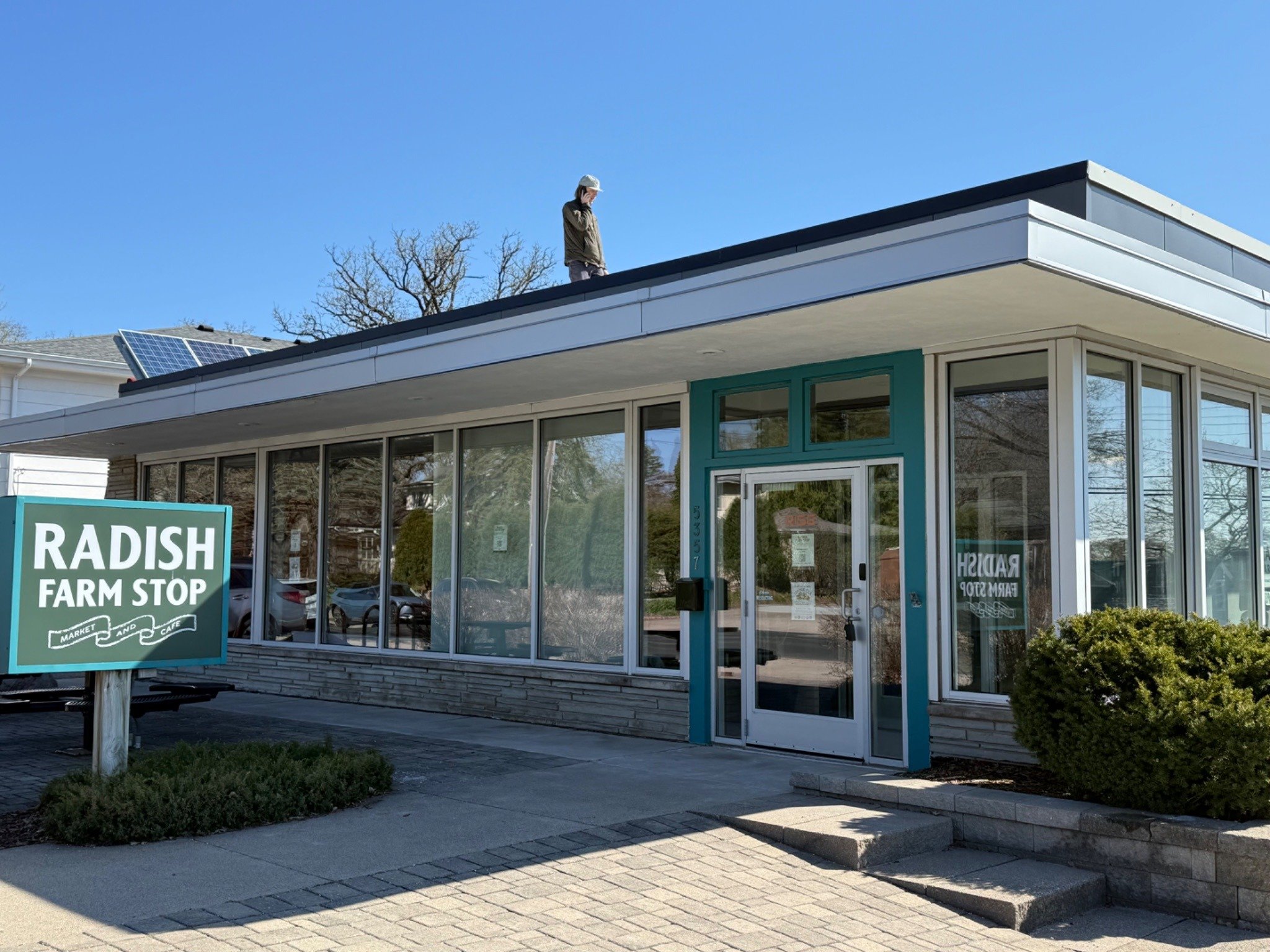
The front of Radish Farm Stop
Sign up for the Radish Farm Stop newsletter online, or visit in person at 5357 Penn Avenue South, Minneapolis, MN 55419. If you do visit, leave a comment here, and let us know about your experience. And be sure to say hello to Lily.