Grandad’s Farm Stop
Madison, Wisconsin has among the strongest local food cultures in the midwest. Farmers markets, co-ops, CSAs, restaurants dedicated to local sourcing. And yet 90% of Wisconsin's food dollars leave the state, and small farms continue to struggle. Patrick Randolph, who grew up in Madison and left for a decade, came back with a mission to address this by creating a new direct-to-consumer sales channel for small farms. This summer, he's opening Grandad's Farm Stop – named after his grandfather, a lifelong farmer – in an old gas station on the city’s west side.
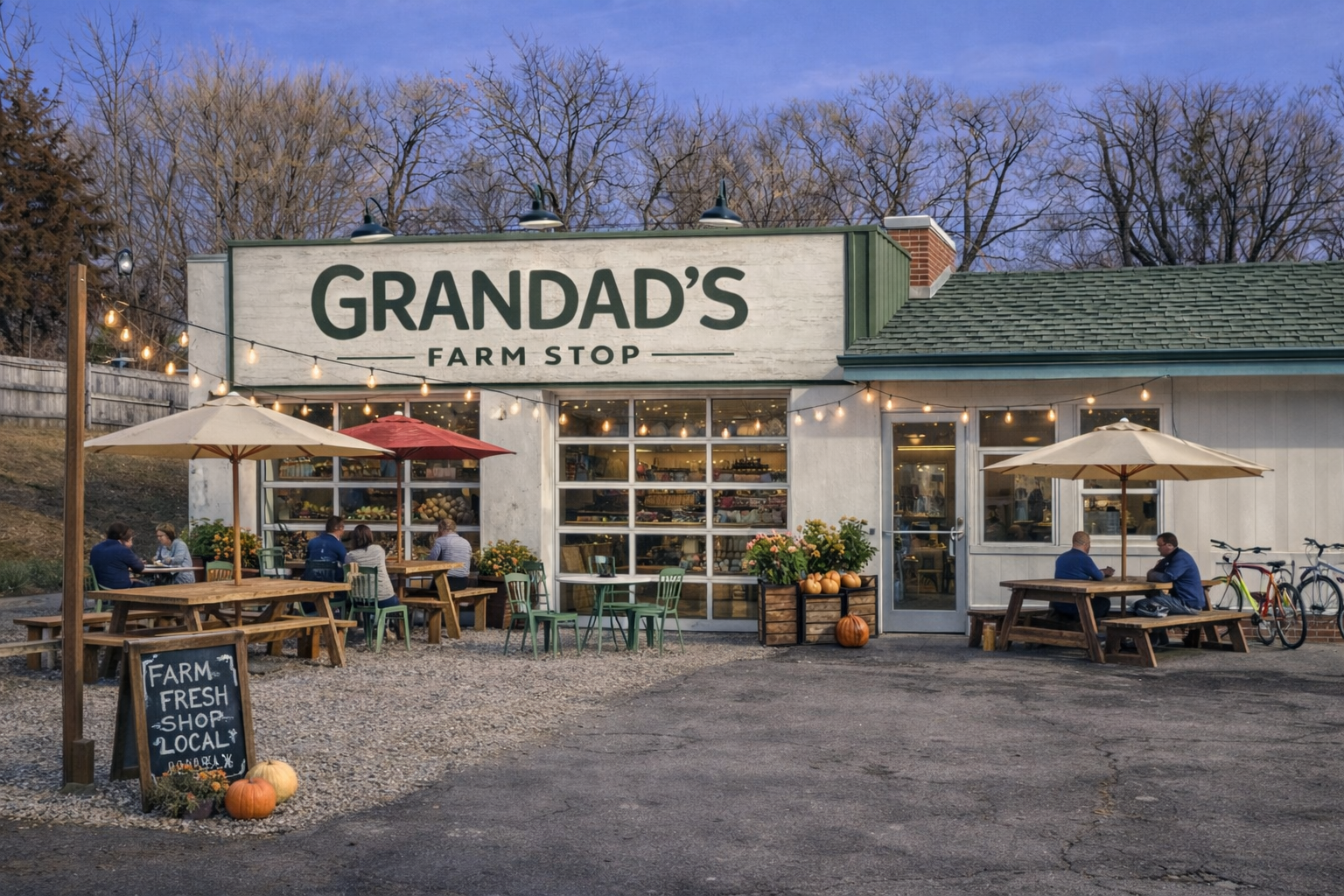
Conception of what Grandad’s Farm Stop will look like once opened.
July 2026
Author: Mark Maynard
MARK: I heard that you’ve secured a location in Madison. What can you tell us about it? Where’s Grandad’s Farm Stop going to be?
PATRICK: It's an old gas station that had turned into a tow and service station, very similar to what Argus Farm Stop started in. It was built in the 1960s, and it remained in operation until we took it over this past March. It's about 1,400 square feet. It's on a very major thoroughfare — if you're working downtown, and live on the west side, or vice versa, you likely pass right by it. There are a lot of houses in the area, and some really good neighborhood communities nearby, with people who are very invested in the community.
MARK: The “let’s use a gas station for a farm stop” model seems to work pretty well. Generally speaking, gas stations are a manageable size, and conveniently located. The only down side, I guess, is remediation. Was that an issue for you?
PATRICK: Luckily, all of the environmental stuff had been taken care of by the early 2000s. The big thing — the gas tanks — were taken out in the late ‘90s. But this building has been caked with grease, and a lot of cigarette smoke, for 60 years now. So getting the space up to retail standards has been a huge undertaking. If you’re looking into a building like this, make sure you’ve done your due diligence.
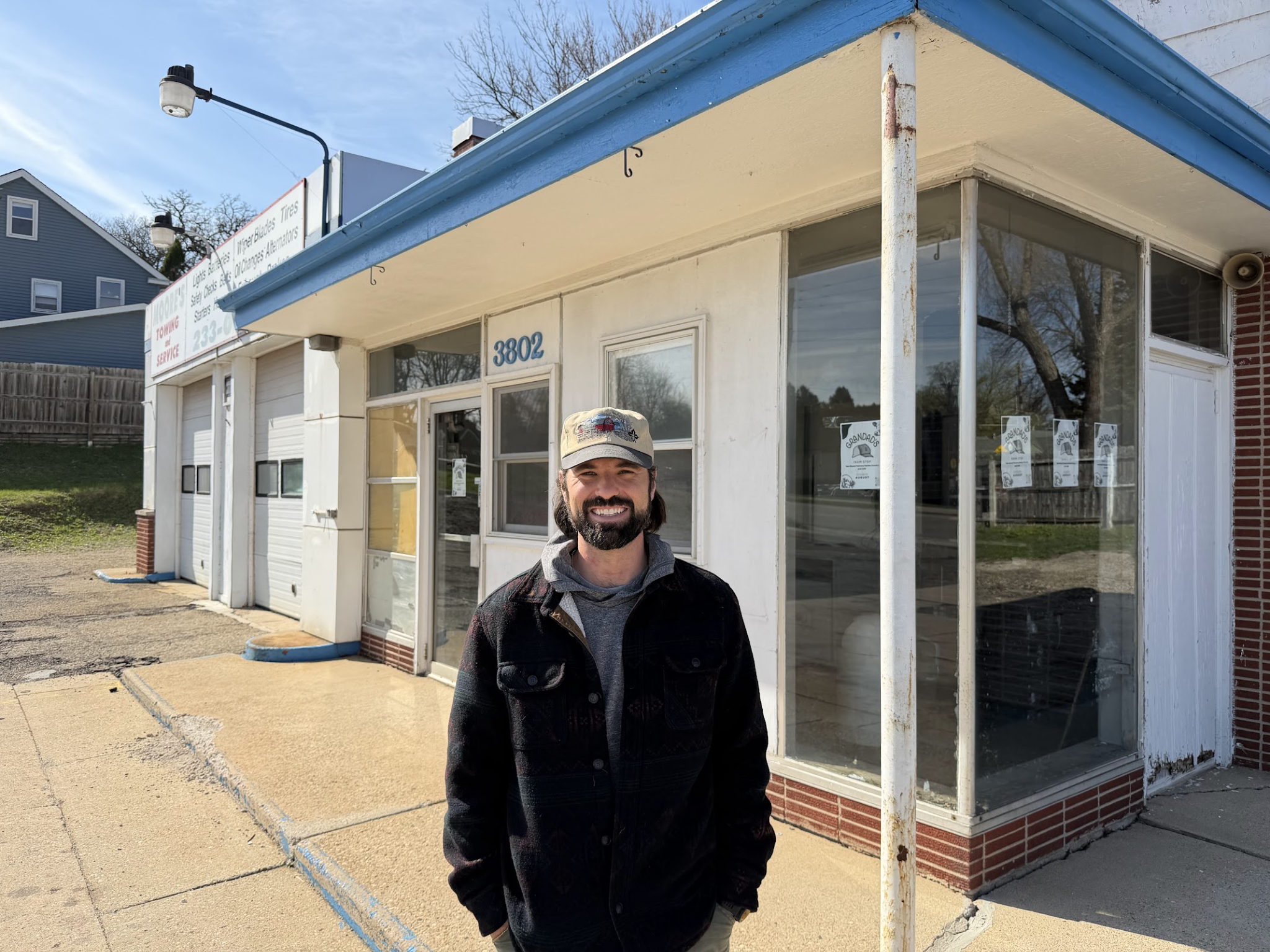
Patrick in front of the building that will become Grandad’s Farm Stop.
MARK: What can you tell us about the layout of the space? You mentioned that there are about 1,400 square feet — how are you planning to divide it up? Specifically, I’m curious as to the divide between the market and cafe elements.
PATRICK: We’ll have about 900 square feet devoted to the market side of things, with a very small cafe area, prep area, and customer bathroom. The layout is almost exactly like the Argus Farm Stop in Ann Arbor, on Liberty Street. Thankfully, we'll also have a large outdoor walk-in-cooler and freezer combo, as well as a shed that’s about 250 square feet, which will have our dry storage and my office. As far as the flow goes, if you’ve experienced the Liberty Argus location, you should have a pretty good sense of how our store will operate. Our market is bigger, and our cafe is smaller, but it is uncanny how similar they’ll end up being.
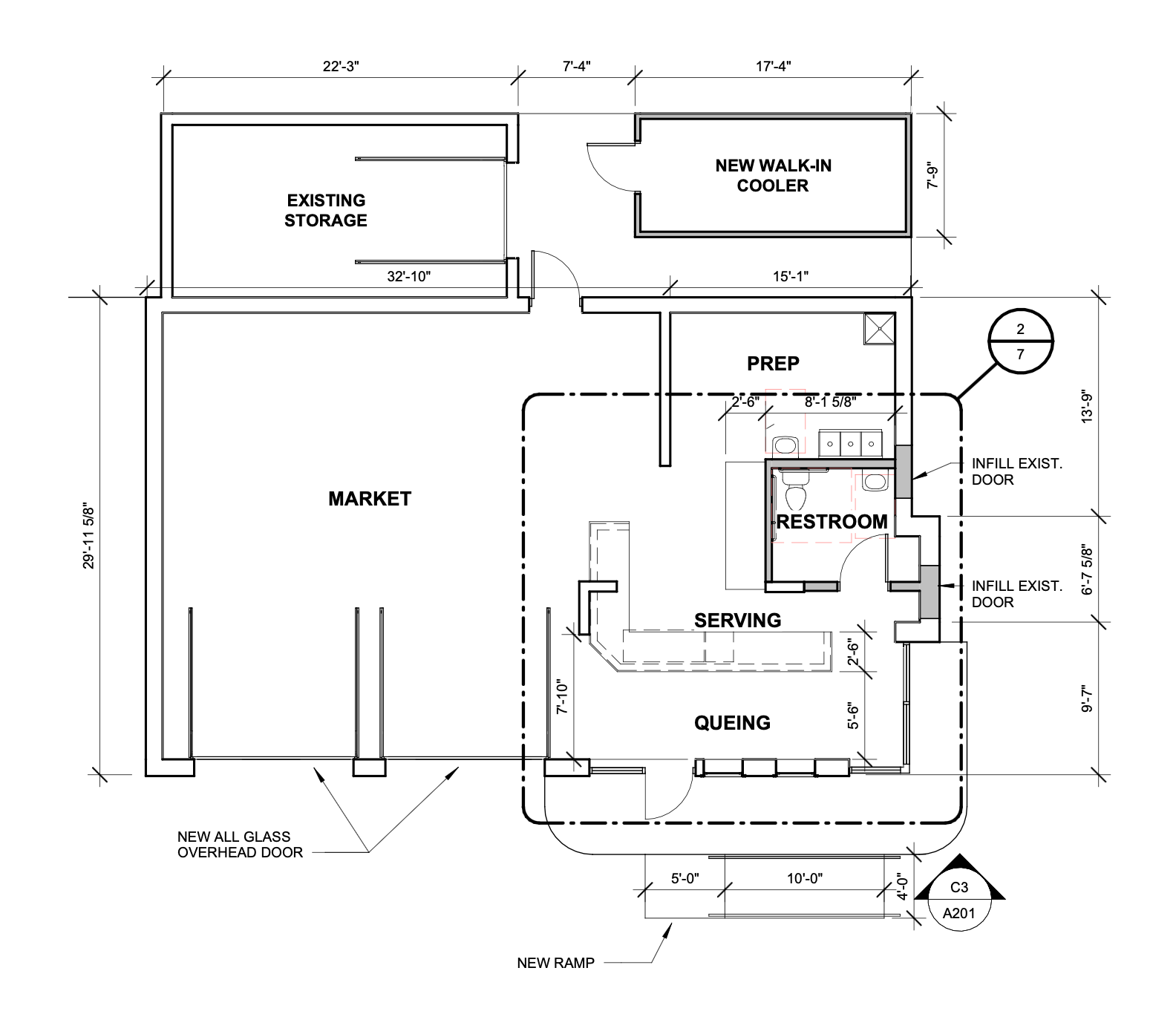
Architectural plans for Grandad’s Farm Stop.
MARK: You’ve got quite a bit of outdoor space, which the Argus Liberty location doesn’t have. In addition to the uses you’ve already shared, what else do you intend to do with that space?
PATRICK: We’re going to have about 13 parking spots, two-way parking lot traffic, and a little under 1,000 square feet of outdoor seating and additional sales area. We’re thinking about outdoor markets, and food truck partnerships, but mostly we want the patio to be a community good, where anyone feels comfortable coming, getting their favorite local good, and sitting down with their people.
MARK: You mentioned that the indoor cafe space was small. I’m curious as to how many seats you’ll have.
PATRICK: Maybe 3 or 4, if we’re lucky. But most likely, none. Our cafe space only has a queuing area of about 4.6-feet by 20-feet.
MARK: Can I ask what the terms of your lease are?
PATRICK: 7 years at around $4k per month.
MARK: How did you negotiate that deal? Is there anything in your experience that you think might be of value to others who are in the process of looking for space to house a future farm stop?
PATRICK: I was fortunate enough to work with a good friend who is also a commercial retail estate broker. I cannot stress this enough – you really should work with a professional, unless you already have real estate experience. I wouldn't have been able to successfully navigate the commercial market without him. Also, don’t be afraid to get creative – profit shares, rent forgiveness, rent tied to sales percentages, partnering with a business that will use the space at night (think wine bar). The sky’s the limit, and the worst thing that you can hear is no.
MARK: Did you pursue any of those things with your landlord? Will your rent rise based on sales? Also, I’m curious as to your plan after the 7 year term ends. Do you have an option to purchase the property at that point?
PATRICK: Our arrangement is pretty conventional after an extended rent abatement, so, no, there’s no revenue sharing. But those were things I spent a lot of time mapping out for a different space, so I know it can be done. My landlord and I have talked about what might happen if the business is successful. Options include renewing the lease, or even developing the property and building a larger space for us.

MARK: Can you talk a bit about the division of work between you and the building owner? Were there things, for instance, that they agreed to do relative to the rehab of the space? And I’d also like to hear more about the rent abatement.
PATRICK: My landlords are great, but they only agreed to rehab the roof, and remove the in-ground hydraulic car lifts. What we were able to work out, though, was 7 months of rent abatement, along with some supplemental rent relief if certain triggers were to happen during our buildout. Basically, they weren’t interested in putting more money into an old building that they might eventually develop over, but they were more than happy to allow tenant improvements through months with no lease payments.
MARK: I’m curious as to how you arrived at this location. Can you walk us through your process? You mentioned earlier that you’d considered another space. Were you actively looking in a number of different neighborhoods?
PATRICK: I had been looking for a space for upwards of 2 years. We went really far down the path at a different location, but it fell through. I had seen this building listed, but had passed it over, as they were hoping to keep it as an automotive garage. But I had my retail rep reach out and get more information. Once we learned that the owner was open to having something different in the space, we went completely in, and started working to get a lease finalized. That was a long process. It took us 5 months to lock-in, which isn’t typical, according to my friend. But it worked out. Over that time, I had my thoughts about the location confirmed by a few of my local farm connections and friends, who told me how much local food moved through the neighborhood here. Someone I trust implicitly said that this was their best selling CSA neighborhood. So I never looked back.
MARK: Were there certain things that you were looking for in a location? For instance, were there a specific number of people within walking distance that you were looking for? Were there any demographic metrics that you felt as though a location absolutely had to hit in order to be considered viable?
PATRICK: I was looking for walkability, a good neighborhood presence, easy access for the farmers, and a large outdoor space. Having grown up in Madison, I know the neighborhoods very well, so, for the most part, I know the general demographics. Most places on Madison’s west side are similar within some slight variation. We wanted to be conservative in our target customer identification, though, to really stress-test the model. We looked at the number of college educated people in the area, with household income of above $80K, and between the ages of 25 to 55.
MARK: Madison has a pretty well developed local food ecosystem already. You have farmers markets, food co-ops, well-established CSAs, and restaurants that feature local produce. I’m curious as to where you see Grandad's Farm Stop fitting into that mix? Is there a niche that isn’t being filled? What do you think that your role is going to be in the larger local food ecosystem?
PATRICK: With such an established local food culture, we have a lot of small farms and food businesses. A lot of those people are really struggling when it comes to sales because the existing sales channels aren’t built for them. We’re filling the gap for the farmer who can’t get into the co-op, maybe doesn’t have the capability to cold-call restaurants, and sort of feels stuck in the farmers’ market/CSA cycle. As far as the broader food system, I want to 1) make buying local a convenient, everyday thing, 2) help grow our local food roster in order to take over for the typical Sysco orders, and 3) develop unique sales channels to turn previously unsellable goods (like produce seconds) into a financial boon for the people who grow it. If we can show people that they can get 90% of what they need week to week locally, and make it convenient, we’ll see a massive shift in the fundamentals of the local food economy.
MARK: Have you had discussions with your local farmers’ market and co-op yet? Do they seem supportive? Is there potential to work together?
PATRICK: We have the largest producer-only farmers’ market in the country here in Madison, and they’ve been very supportive. We’re also working with a lot of the farmers’ market managers just by happenstance. They’re all very involved in local food, and a lot of them will be selling their own products in the farm stop. We haven’t talked to the co-ops yet, but we all have the same mission – moving as much local food as possible.
MARK: I was talking yesterday with someone else starting a farm stop in a midwestern college town, and she was a bit apprehensive about reaching out to her local farmers’ market manager, as she was concerned that they might see the farm stop as a threat to their business. I gave her some thoughts, but I was wondering if you have any advice as to how she might want to frame her outreach.
PATRICK: I’d suggest you go in humbly, and ask for their opinion. Get their thoughts on where their farmers are struggling, where they see opportunities, what might be your biggest hurdles, and how you can be of help to them. Farm Stops are a new entrant into a lot of the city/college town food systems and we have to be okay with that. There are people who have been doing food systems work in your community for decades. Learn from them! I always tried to express that I wanted to learn from them, and that I didn’t think I was going to come in and change the entire ecosystem. Each manager will be different, but I think it’s our job to help them see that we’re all rowing in the same direction. If the farmers and producers don’t have sustainable businesses, then they won’t have anyone to sell food at the market.
MARK: In addition to the market and the coffee shop, will you be starting with any other elements, like produce boxes, for instance? Is there an opportunity for a “food as medicine” partnership?
PATRICK: We would love to do a “food as medicine” partnership, but Wisconsin isn’t as far along as Michigan when it comes to those kinds of local food programs. We’ll do something called “What’s for Dinner?” boxes, though. A local chef or farmer will provide a recipe with all local ingredients, and then we’ll gather what you need, and have the box ready for you when you come in the door. No more stressing about what to make for dinner on your way home, which is a constant struggle in our house.
MARK: That sounds promising. I can’t wait to hear about the rollout, and how the program goes. Have you thought about aggregating from your partner farms to offer a CSA? If you did, and decided against it, I’m curious as to why. Is the local CSA market saturated, or is it more a question of bandwidth at the outset?
PATRICK: It’s a lot of not wanting to bite off more than I can chew. I understand we’ll probably do something like that in the future, but, to be honest, it doesn’t excite me personally. I think the CSA model has a lot of flaws for both the consumer and the farmer, and it isn’t how I like to eat. But if our community is interested in that, I would get it up and running.
MARK: Can you talk a little about your marketing plans? I’m curious as to how you’re planning to get the word out about Grandad’s Farm Stop, your mission, and how the model works?
PATRICK: Right now we’re sticking to Instagram and word-of-mouth. One thing that did fall in our lap – we’re going to be sponsoring the surrounding neighborhood associations’ “Summer Nights Events”. These events draw close to 1,000 people, especially the 4th of July one. That will be a great way to meet our customers, and get our name out there. Eventually, we'll start doing some targeted ads in the local food magazines and blogs. Also instagram and facebook ads are part of our plan.
MARK: I know, here, in Ann Arbor, even after a dozen years, there are still people who don’t realize that farmers set their own prices at Argus, and get 70% of that sale price. And I’m curious if you have thoughts as to how you’ll convey those facts.
PATRICK: The one that I keep coming back to is having some sort of counter on the wall that tracks the amount of money that has gone back to the local farmers and producers. I would love to watch that tick up day after day as the sales grow.
MARK: Lily Gross, who is opening Radish Farm Stop in Minneapolis this summer, credits you with helping her get this far in the process. I don’t remember if she specifically used the term “accountability partner”, but there was a sense that you were pushing one another forward in your work. How important has it been for you to have someone like Lily, who is essentially on the same launch timeline as you are?
PATRICK: Lily has been possibly the most important professional partner in this entire endeavor. Since 2024, we’ve been meeting regularly to check in, bounce ideas off one another, and just keep each other motivated to follow through. I felt like, in the beginning, I was pushing her to believe and take the leap, and now that we’re both so close, she’s absolutely carrying me to the finish line. There is no doubt in my mind there is no Grandad’s Farm Stop without Lily and Radish. I don’t know if you have to have another person starting a farm stop at the same time, but I do know you have to have someone you can share the experience with in a professional sense and who can keep you moving forward when you get stuck.
MARK: Did you know Lily before the first Farm Stop National Conference, or did you meet there?
PATRICK: We met at the first Farm Stop Conference in 2024. It felt like there were about 4 of us who were seriously considering starting a farm stop – Jim Livley of Livley Neighborfood Market, Jacob Inosencio at Grow Jackson, and Lily from Radish. At the most recent conference, I think at least 50 people were interested in starting Farm Stops, so the movement has come a long way... Lily was the one who made the connection with me, and it’s been history ever since.
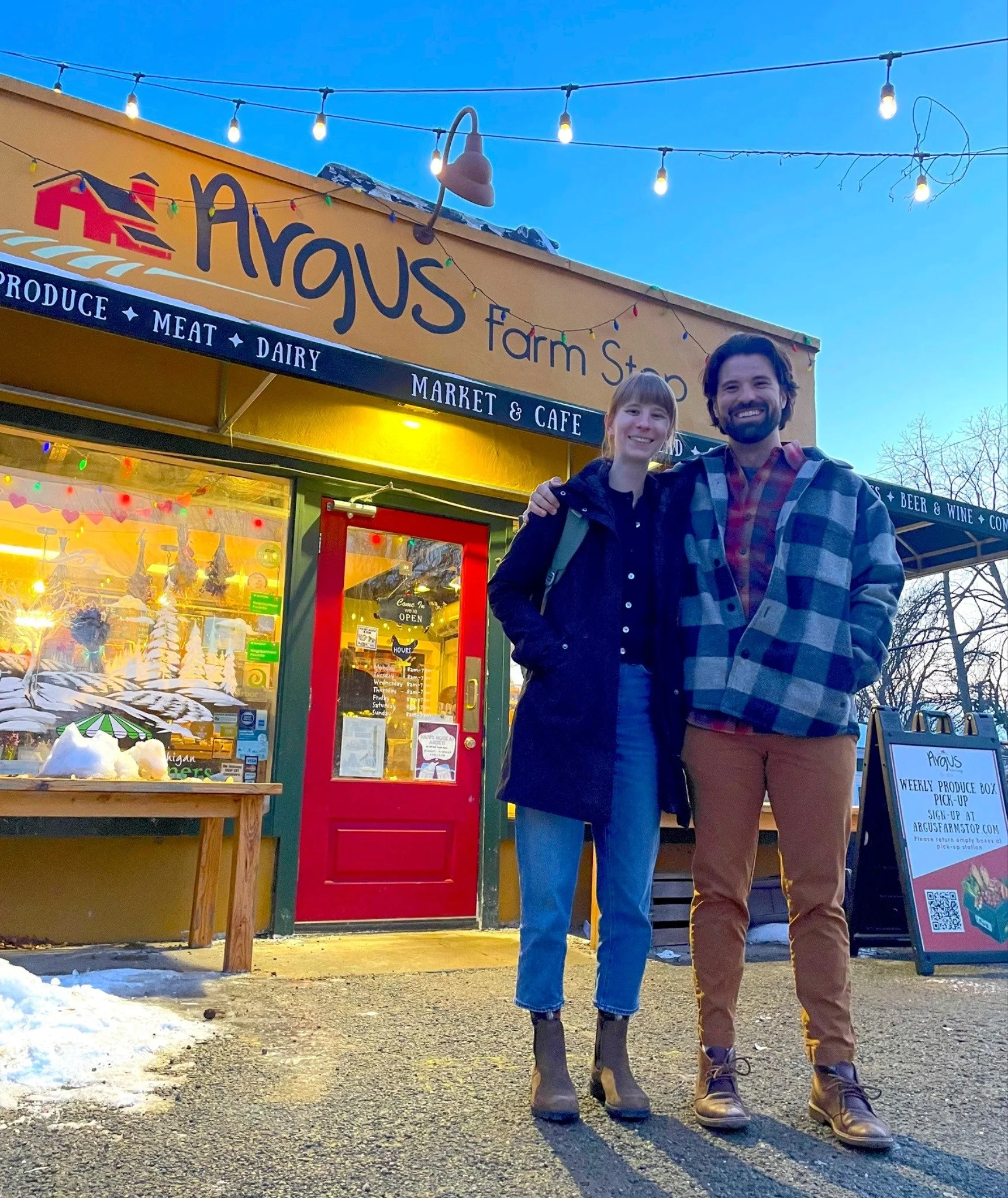
Patrick with Lily Gross, outside the original Argus Farm Stop location in Ann Arbor.
MARK: Assuming you read my recent interview with Lily, I’m curious to know your thoughts on what we covered. I’d like for this series to be relevant to people like you, who are out there starting farm stops, or thinking about starting farm stops, and I’d like to know if, from your perspective, there are things that you were hoping that we’d touch on that we didn’t.
PATRICK: I really liked how you were able to dig into certain topics like farmer/producer selection. I think finding places where a person who’s interested in starting a farm stop can really go in-depth into the non-sexy topics like “refrigeration requirements”, or “farm stop build out”, is extremely helpful. Farm Stops are a very easy sell for those who are versed in local food, but the nuts and bolts of starting and running one will always be more complex than they appear.
MARK: OK, as you mentioned it, what’s one refrigeration-related lesson that you’d like to pass along to the next person out there thinking about starting a farm stop?
PATRICK: Don’t try to go too deep down the rabbit hole. Find someone who knows what they’re talking about, and has a great reputation in the area. If you’re in the Midwest, I’d suggest Thrane Equipment. But, more in the spirit of your question, pay attention to floor drains!
MARK: What brought you into the world of farm stops in the first place? How did you become aware that the model existed, and what was it about the model that you found compelling?
PATRICK: In 2021, I left my job in Youth Leadership Development at The Aspen Institute to manage a small 40-person CSA farm. Coming out of Covid, people over-promised what they’d buy. We had an adjustable box model, and they over anticipated what they’d want. Well, the owners were extremely generous, and donated all the extra produce that we were growing but couldn’t sell. I thought to myself, “I wouldn’t be able to do this if this were my farm. It would be cool if I could just drop this off somewhere, and have someone sell it for me.” Originally I imagined an old antique mall like my mom used to drag me to as a kid. When I started to pursue the idea seriously, in late 2023, someone mentioned, “That sounds like Argus Farm Stop in Ann Arbor.” I dove in feet first, and haven’t looked back.
MARK: I know you have a long history in Madison, but I’m curious if you were born there.
PATRICK: I was born in Kansas City, Missouri, but we moved up to Madison when I was 7. My dad was in Animal Health, and got a job for ABS in Deforest, Wisconsin. I eventually left to go to the University of MIssiouri, spent time on a Caribbean island called Dominica, got a Masters at Loyola Chicago, and then came back to Madison before doing a 1 year stint in Seattle. We are back here now, and are finally putting down roots.
MARK: My assumption is that, right now, in Madison, you’re facing some of the same issues relative to small farm viability that we were here in Ann Arbor when Bill and Kathy decided to start Argus. How are your local small farms doing right now?
PATRICK: Ups and downs. Losing things like the LFPA, along with other local food programs, have really hurt a lot of farmers. Madison does have a strong local food community, though, so some pieces are being picked up. But we continue to lose farms all across the state, and the sales volumes are nowhere near the rates you’d expect us to have with all the local food being grown in Wisconsin. 90% of all Wisconsin food dollars go out of state, and we have an excellent culture of direct-to-consumer (DTC) sales compared to other states. If farmers are struggling here, I’d hate to see other states.
MARK: As of right now, how many farms do you have signed-on to sell through Grandad’s Farm Stop?
PATRICK: We have 54 farmers and producers signed on right now, with about 5 or 6 more hopefully signing up soon.
MARK: How many farmers do you need by opening day to make this work? What's your minimum viable number, and what's your target?
PATRICK: We will open with no gaps in produce or meat. Those were the easiest for us to sign up, especially the meat producers. They got it right away. And I feel really good about where we are product wise. We’ll continue to add farms and businesses as we go to fill gaps obviously.
MARK: When I spoke with Lily about the farmers she’s working with in Minneapolis, she mentioned that she was finding it difficult to recruit fruit growers. Are there any holes right now in your product mix, and, if so, how do you plan to fill them?
PATRICK: Fruit is hard because they legitimately don’t know if they’ll have a crop until late June or early July. We lost both of our fruit growers last week due to really bad frost damage. They got hit hard with the late spring frosts. Other than that, I’d love to have a more robust snack aisle. There are no potato chip makers in the state who sell at any sort of scale. It’s just about going out and finding as many local producers as you can. I stay up late and comb through every farmers’ market roster. Another great way to find products is to go to other small stores selling local foods. I always learn about a new thing when I go to those places. A lot of hard work will always be the answer.
MARK: Can you talk about your outreach process? How did you get the word out to your local farmers that you were doing this? Did you hold public meetings, or was it mostly just one-on-one outreach to folks at your local farmers’ markets?
PATRICK: The thing I started with, and it served me well, was large outreach from our local farmers union and two local non-profits that work closely with small scale farmers in Wisconsin. Those relationships had been built over the past couple years, and, through them, I started to get into the food systems world here in Madison. With those trusted organizations vouching for me, the name Grandad’s Farm Stop started to be recognized. With that, people didn’t just dismiss communications I sent right off the bat. Then it was individual outreach, cold calls, emails, and going to a lot of farmers’ markets.
MARK: What’s the farmer response been to the consignment model?
PATRICK: I’ve only had a few farmers not like the concept. They’ve pointed out (legitimate) concerns around distribution of risk among a few other things. But, even if they didn’t love the model, or didn’t want to sell in the store, they were still super supportive of someone trying to make it easier for more people to buy more local food. For the most part, everyone is very excited about the opportunity. Just as with any new thing, I’m sure, once I’m able to show a proof of concept, I can earn the trust of even those farmers who don’t like the model right now.
MARK: How’d you identify those farmers that you wanted with you at the outset? I imagine you’re trying to walk a line. On one hand, I suspect, you want small growers, who will really benefit from this new sales channel. On the other, though, you probably want farms that you know you can count on, farms that maybe have a broader product offering, some retail experience, etc.
PATRICK: My whole model is built like a football depth chart. We have primary producers in every category who will do the bulk of supplying that certain product. That primary producer could be any farm of any size. We’re just trying to create an equitable place where everyone feels they are gaining from being at the Farm Stop. Then, I have “back ups” that are primarily larger, more established farms. These are the farmers I know who I could call any day and get 100 pounds of tomatoes without a problem. It’s these farms that allow us to give smaller and less established farmers the opportunity to sell for us. Those larger partners are pretty easy to come by up here due to my connections in the farming community. I’m lucky to have good connections from my time working as a farm hand. It’s a small community and everyone knows someone who knows someone. I imagine it’s similar in most small ag communities, no matter the size of the area’s population.
MARK: What’s the big vision that motivates you?
PATRICK: The end goal in my mind is having everything possible be local, and not just at Grandad’s Farm Stop. I’d like every local grocery store to have as much locally grown food as possible. In order to do that, we have to build the capacity of every local farm. The biggest ones need to be able to take over the existing supply chains that our locally owned grocery stores rely on. The medium ones need to then level up. And the same with the small ones. Plus, we’ll likely need to start more. But I also want to recognize it is not the job of every local farmer to change the entire food system. So I want to make sure that Grandad’s can support all of those farms in whatever end goal they have. If a small farm wants to work to be the biggest supplier of garlic in the area, let’s do it. If a medium farm wants to just sustain a great lifestyle for them and their family, I am here for them. And if the largest farm in the county is ready to start winding down production but wants to continue to bring some of their food to market, then I’m their guy… I think Farm Stops have to work for every farmer.
MARK: I know it’s probably difficult to choose, but can you tell us about one of the farms that you’re working with?
PATRICK: Wonka’s Harvest was the first produce farm that signed on with us. Patty has been farming her land for 6 seasons now. Patty and her team grow pretty much all the produce you can in the 5b zone as well as doing dried herbs. They’re going to be one of our biggest suppliers and their no-till practices give them a direct connection to my own Grandad, who swore by no-till. Also, Patty has developed a “pay-what-you-can” CSA model to help with local food access in her area. Basically each box has a retail value, and a suggested price. You can pay more than that price, essentially sponsoring a neighbor, and spread Wonka’s Harvest’s mission of ensuring everyone has access to safe, nutritious, and culturally appropriate foods. Or if you have less, you can pay as little as 50% of that week's suggested price. I was so stoked when they signed on to sell with us and I cannot wait to tell their story more.
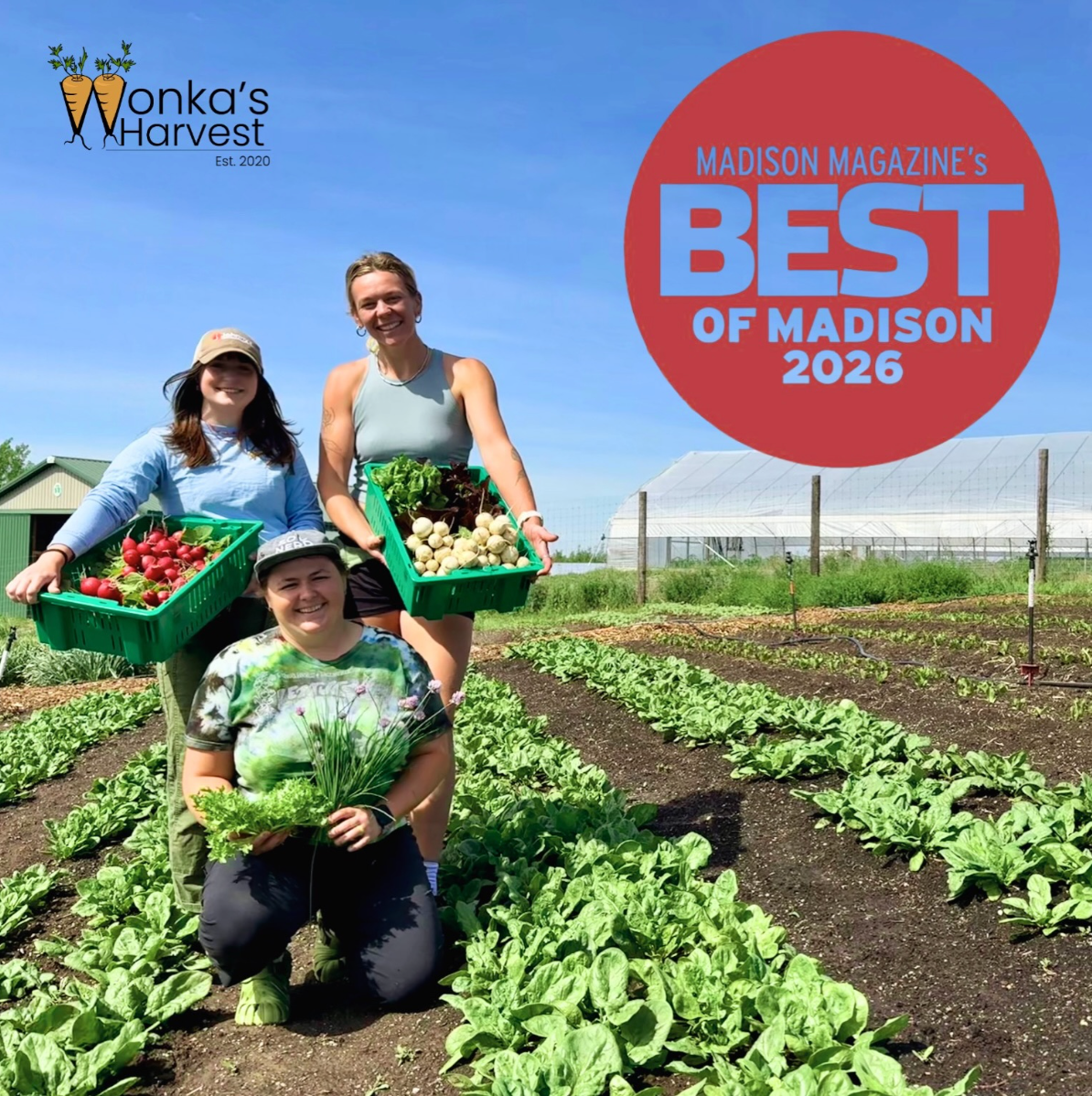
Wonka’s Harvest will be among the first farms to sell Grandad’s Farm Stop.
MARK: Let’s talk about the financial side of things. When everything is said and done, how much is it going to cost you to get Grandad’s Farm Stop open?
PATRICK: Just under $500,000. About half of that is built-out, but I’d be shocked if anyone could have done it cheaper here in Madison. Not to be a downer, but if you’re interested in starting a Farm Stop in a place with a population 250,000 or bigger, I would strongly suggest having a viable path to that much capital. I’m not saying you’ll need to use all of it, but having that squared away will make this process so much less stressful.
MARK: I saw that you received a facade grant from Madison to work on the exterior of the building. Were you able to secure any other grants, or are you doing this solely with loans?
PATRICK: Unfortunately, no, most local food grants that I’ve found require at least two years of operating experience. Getting a grant for a startup is very hard in my experience. We are self-financing about one-third of it with loans, and this facade grant is covering the rest.
MARK: Just so I’m clear on this, how much of the $500K total are you borrowing, and how much of the overall budget will this facade grant be covering?
PATRICK: The facade grant is only about 6% of our costs. I put in 30%, while we financed 64%.
MARK: As for the money that you borrowed, I was wondering if there was anything that you could share about the process. Did you end up going with a traditional bank?
PATRICK: We went with a credit union and felt really good about it. They seemed to have a much more relaxed model for us as far as payment structures and upfront requirements. A credit union’s mission is different than a traditional bank. Stay away from the national banks for sure. But also make sure to go to at least three financial institutions in your community. The worst they can say is no, and I actually gained invaluable feedback on the project just by talking to the loan officers who are often active in the community.
MARK: What does your break-even look like? How many customers per day, at what average basket size, do you need in order to cover your costs?
PATRICK: We are projecting 80 customers a day in both the market and cafe, with an average sale of $25 and $7 respectively. With growth averaging per quarter at about 4%, we will be profitable in year two. The big thing is we will always be cash flow positive if our projections hold.
MARK: Given the relatively small size of your cafe, are you concerned at all about making these numbers in the winter, when your outside seating becomes less of an option for guests? I’m wondering if you might find yourself in a position where, like Argus, you’re looking to add a greenhouse or something down the line.
PATRICK: Yup! I’m more than worried about it. One of our first investments in the store will be a similar indoor seating space like Argus. Wisconsinites are hardy people though, and we’re used to harsh winters. So my theory is we might be able to put fires and heaters out there for some winter seating. I’m also looking into one of those bubble seating things that you saw become popular during COVID.
MARK: As I understand it, you’re planning to be the General Manager. How many others do you plan to have on your team, and have you already started hiring?
PATRICK: Hopefully, by the time you’re reading this, I’ve hired our Store Manager, and I’ll be in the process of bringing on two more full-time staff. After that, we plan to have 4 to 5 Store Clerks filling in the rest of the schedule.
MARK: What were you looking for in a store manager in terms of experience and skills?
PATRICK: Well, at first, I was hyper focused on someone who could take the cafe aspect of the farm stop and just go. I wanted to be hands off. But, after reflection, I realized I needed to hire someone for the next 6 years, not the next 6 months. I wanted someone who, if I were to step away, could pick up the mantle and continue the mission. Also being able to “speak farmer” ended up being a big selling point for me. While the cafe is the backbone of the operation, and you have to have good coffee, the heart of our place will always be the farmers.
MARK: As you’re planning to open this summer, I’m curious as to where you are in the process. Where are you relative to construction? What still needs to get done?
PATRICK: So we have the demolition done and we’re working on roughing in the plumbing and electrical. We should have the full building permit within the next few weeks, and we'll be sprinting to August. I will be doing all of the painting, floor work, and finishing refurbishing the shed for storage and my office. We have a good plan and all of my trades guys are confident we’ill get it done.
MARK: What part of this process has been harder or different than you expected?
PATRICK: Not having control of every little detail has been very hard for me. I like to have control over things like this, but you have to put it in the hands of professionals. That hasn’t served me perfectly, but it’s what has to be done.
MARK: You decided to name your farm stop in honor of your maternal grandfather, David Lillis Barr, who was a life-long farmer. On your website, you mention that, in your last conversation with him before he passed, you talked about the future of agriculture and the importance of sustainability and stewardship. I was wondering if you could tell us a little more about that conversation.
PATRICK: So Grandad left the farm at age 88 to take care of Grandmom. She had Alzheimer's, so they moved into town to be closer to her doctors. After she passed away, Grandad moved in with my parents. He would spend his time in his basement apartment, learning as much as he could about anything that interested him. Well, I thought he’d get a big kick out of seeing how intensive regenerative ag could transform barren cheap pieces of dirt into fertile farmland, so I got him started down that path. He couldn’t get enough of it. Being the constant landman, he saw the economics behind it as well as how important it was that these farmers were working with the land. It made a lot of sense to him as a soil conservationist. He wanted to learn more about how people were doing it, and start applying it to his own land. (He still owned our family’s 1,500 acre farm.) Well after about two hours of digging into it with him, I had to go. Four days later, he was gone. I wish I’d had that conversation with him so much earlier, but it will always be one of my favorite memories I have with him.
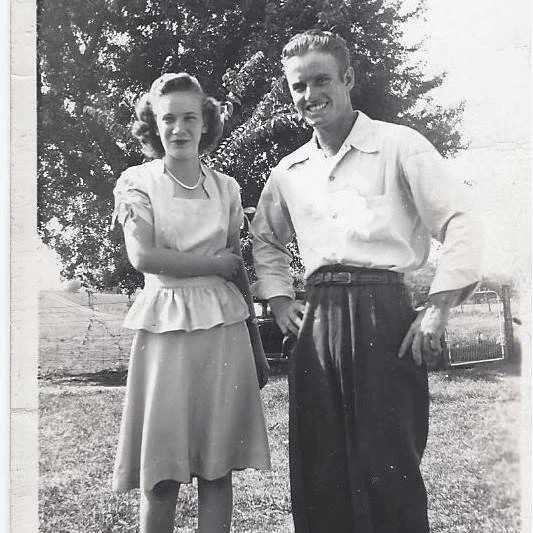
Patrick’s grandparents Dorthy (Cupp) Barr and David Lillis Barr in 1948, the year before they were married.
MARK: What advice would you give to someone who is thinking about opening a farm stop?
PATRICK: Have a team or a partner. It is possible to do it alone, but if you do not absolutely have to then you shouldn’t. It's a rewarding process. Hard, but rewarding. There is no need to make it harder than it already is.
MARK: You mention that Lily in Minneapolis serves as your accountability partner, and that you had to lean pretty heavily on your commercial real estate broker, but who else do you have on your team there in Madison? Do you have other friends, advisors and partners?
PATRICK: Professionally, I have a business advisor through the Small Business Development Council. I've also outsourced my accounting to a small business here in Madison. I do have a person working about 5 hours a week on small projects, but it has really been just me doing everything. I lean on my wife Allie heavily. She has been doing a lot of things in addition to her very demanding job. Also, my best friend and neighbor is in food systems developing a local food social marketplace so we lean on each other quite a bit.
MARK: Could you talk a bit about the role of Argus beyond just the conference? Have you gone to them with questions, taken classes, etc?
PATRICK: All the time. Laura, Casey, Bill, Rosie, and the whole team have been so helpful. I would suggest taking as many of their classes as you can, and setting up a formal consulting contract so you can get the most out of their time. The hardest thing when starting any business is all of the decisions you have to make. Argus and their team have already made those decisions, found out why they were bad ones, and then made the right ones. Don’t look that gift horse in the mouth. They are an invaluable resource and I couldn’t get Grandad’s open without them.
MARK: If people want to follow your progress, I see that you have an Instagram page. Is there any other way to keep track of your progress? Do you have a newsletter?
PATRICK: That’s the best way. As the primary care taker of two little girls, I don’t have time to do much else in self promotion. But that’s a good thing. People don’t need to see my face more than what they are getting now.
MARK: One last question. It's August 2027. You've been open a year. You’ve just made it through your first full growing season. You’re looking around Grandad’s, taking stock of things. What do you see? Can you visualize it?
PATRICK: Honestly, Mark, I can’t see it right now. My whole mind, body, and soul is working to get Grandad’s open within the next seven weeks. August 2027 is what I call “a future thought for a future me”. I can’t wait for that time though!
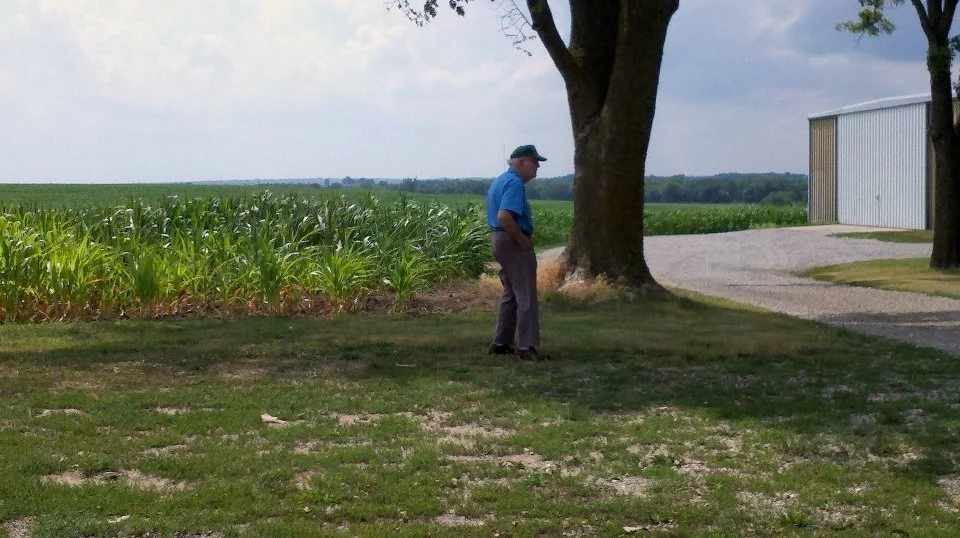
Patrick’s grandfather, David Lillis Barr, on his Marshall, Missouri farm in 2010.
Stay up-to-date on the progress of Grandad’s Farm Stop on Instagram. And, when they open, visit them at 3802 Mineral Point Road in Madison, Wisconsin.