TakeRoot Farm Stop in Dundee, Omaha
Omaha doesn't have the same small farm density as Ann Arbor or Madison. When Carla Gornall and her partners opened TakeRoot Farm Stop this past December, they had to think differently about sourcing. In this month’s Farm Stop Journal, we talk with Carla about the regional sourcing model that TakeRoot has constructed, what it means to fill product gaps with intentionality, and the role of a Farm Stop in growing local food systems.
August 2026
Author: Mark Maynard
MARK: I’ve known you and Gordon for a few years now, but I don’t think I know how you met one another, and how this whole Farm Stop journey started for you both.
CARLA: I served as the Local Food Procurement Coordinator for a nonprofit in Omaha during the pandemic. In that role, I managed a CSA produce box program serving over 500 weekly subscribers. This required partnering with more than 40 farmers. One of the farmers supplying produce was Gordon, and, over time, we developed a strong friendship. After the pandemic, I continued working with Gordon on his farm, and at a weekly farmers’ market. As sales at the market steadily increased, we began to see the potential that a year-round farmers’ market could have for local farmers by providing an additional sales channel and helping extend their selling season. Our other partner, Matt Johnson, discovered the Argus Farm Stop model and training program through social media. I enrolled in their three-day virtual training program, and, shortly afterward, Gordon and I attended the first Farm Stop National Conference. After learning more about the approach, we became convinced that the Farm Stop model could work in Omaha.
MARK: Can you give us a sense of your timeline after that first Farm Stop conference in 2024? Like, when did you hold your first meeting with farmers to propose the idea? When did you secure a space? When did you start construction? And when did you open your doors?
CARLA: Gordon and I had already spoken with several farmers and ranchers prior to discovering the Farm Stop model. After the conference, Gordon and I continued those conversations over the summer of 2024, talking with people about the Argus model. Farmers and ranchers were excited about the idea of being able to set their own prices, and receiving 70% of their sales. The biggest question from our potential producers was, “When?” We visited several potential sites for the store, and finally found a building that checked most of the boxes in June of 2025. And we launched on December 6, 2025. We had high expectations of being open earlier, but it took until September 2026 to begin construction due to the permitting process.
MARK: What can you tell us about your store’s location? You’re in the Dundee neighborhood of Omaha, correct?
CARLA: Yes. One of the biggest challenges we faced was finding a location where TakeRoot could thrive. After touring dozens of properties, we discovered a relatively new building in Omaha’s historic Dundee neighborhood. Located in the heart of the community, the site is surrounded by century-old homes and buildings, and is easily accessible on foot from all directions. TakeRoot sits along Dundee’s main street, alongside a variety of locally owned restaurants and small businesses, making it a natural gathering place for residents and visitors alike. Because the building had previously operated as a furniture showroom, it required minimal renovations. The primary improvements involved updating the electrical and plumbing systems, allowing us to open with relatively low build-out costs.
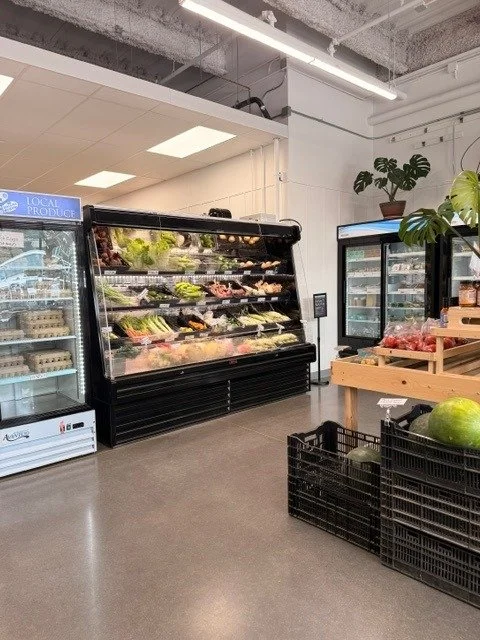
Inside the TakeRoot Farm Stop.
MARK: Are there any other grocery stores in your area?
CARLA: We have a Walmart Neighborhood Market about a half-mile away, but the next grocery store chain beyond that is a mile away, and their local offerings are minimal. Many of our guests here at TakeRoot are from surrounding neighborhoods. Based on conversations with them, it seems as if they’re intentionally choosing to shop here because they value locally-sourced food. They want to support local farmers, ranchers and businesses.
MARK: How many square feet do you have? And I’m curious to know the terms of your lease. Were you able to get reduced rent at the outset?
CARLA: We lease about 2,500 square feet. Our first 6 months were NNN only, while we were building-out. The next 6 months, which started upon our opening, we paid half of the agreed terms. We just recently started paying our full lease payment plus NNN, and that term is 5 years.
MARK: So, you’re now at full rent. How much is that, if you don’t mind my asking?
CARLA: Including NNN, it’s nearly $6,000 per month.
MARK: Let’s talk for a minute about the layout of TakeRoot. As one of your objectives is to have TakeRoot serve as a community gathering place, I’m curious as to how many seats you have. I’d also like to know how your square footage is split between the market and the cafe?
CARLA: We currently aren’t able to have “cafe” seating, as, within our County, we would have needed a third bathroom. While we would love to have seating in the future, it just isn’t feasible to build a third bathroom. We did just start selling to-go coffee on August 1st, though. As for our being a community gathering space, while we don’t have cafe seating right now, we have a certified kitchen that allows us to host educational programs, workshops, and meetings.
MARK: Do you have the space for a third bathroom, should you decide to build one later on? Or, is there a chance that you could petition the City or County for a waiver, so that you don’t have to build a third bathroom?
CARLA: We don’t have space for a third bathroom, so that’s not an option. And, yes, we’re hoping to get a waiver from the City, as our primary purpose is as a grocery store, rather than as a cafe.
MARK: I’d like to ask you about financing, and how you were able to make this happen, but let’s start with what it cost. How much money did it take for you to get open?
CARLA: Our start-up costs were approximately $220,000. About $20,000 of that was for our coffee equipment, which we’ve just now started using, at our 9-month mark.
MARK: How did the rest of that $220K break down? How much was refrigeration, construction, etc.?
CARLA: Construction was our largest line-item, coming in at close to $75,000. Refrigeration was just over $26,000. We saved thousands by buying a used walk-in cooler. Everything else was new. Another big line-item was wholesale product inventory, which came to approximately $35,000. We also spent about $12,000 on our POS, software and printers. And we spent $13,000 on marketing, website design and attorney fees. The remainder, after the $20,000 we spent on the coffee equipment, was used for shelving, sinks, displays and other miscellaneous items.
MARK: On the funding side of things, were you able to secure any City, State or Federal grants for TakeRoot?
CARLA: Not at the outset. We just received a grant through a Rural Health Transformation Program, though, for a refrigerated van. We’ll be picking-up produce and proteins from farmers and delivering them to rural schools. To finance our startup costs, each owner contributed an amount they were comfortable investing. We also secured a loan backed by personal assets to provide the additional funding needed to launch the business.
MARK: How many owners does TakeRoot have? Are there farmers owners other than Gordon?
CARLA: There are three owners, two of whom are farmers. Gordon Miller farms his own farm, Grandview Farm, in Fremont, Nebraska. Matt Johsnon owns and farms Long Walk Farm in Council Bluffs, Iowa. And I’m the third owner. I run the day-to-day operations with a lot of help from both.
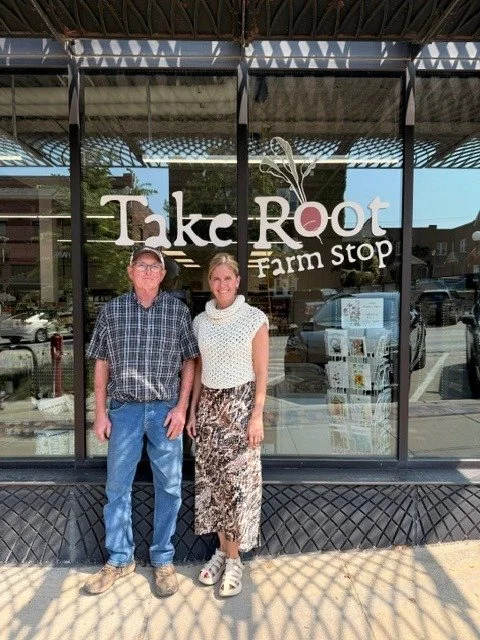
TakeRoot Farm Stop co-owners Gordon Miller and Carla Gornall.
MARK: I’m curious if you ever considered the idea of launching as a farmer-owned co-op, like the Bloomington Farm Stop Collective in Bloomington, Indiana.
CARLA: We tossed around the idea of a co-op and met with Open Harvest Co-op in Lincoln, Nebraska prior to finding the Argus model. We also briefly explored the non-profit route. We decided on an LLC for several reasons. Primarily, we knew that we could launch more quickly with only the three of us making the decisions.
MARK: The last few interviews that I’ve done for this series were done with folks in the process of getting their farm stops launched. So you’re the first person I can pose this question to... How’s business?
CARLA: Business is growing. Launching during the holiday season gave us a strong start. Our first month saw tremendous sales, due to holiday gift-buying. Although it took a few months to return to the sales levels we achieved during our opening month, we’ve reached that milestone again. And, now that we're in the abundance of the summer, we're seeing sales increase even more. We’re excited to continue building on this momentum.
MARK: It might be too early to answer this. Maybe we should follow-up once you’ve had an entire year of sales data to look at, but I’m curious as to the breakdown between the various segments of your business. Do you have a sense as to the breakdown between produce, meat, bakery items, shelf-stable grocery items, etc.?
CARLA: Here’s the breakdown between our largest sales categories in early June; pantry was at 23%, meat was at 15%, and produce was at 13%. Not too long ago, our meat and produce were closer to 30% each, and we expect it will likely increase as our produce deck continues to fill with the seasonal summer produce, and people are looking for thawed meat for grilling. As our business continues to evolve as a neighborhood market, locally produced pantry items will likely remain one of our largest sales categories.
MARK: So, between pantry, meat and produce, you account for 51% of sales. What other revenue streams and sales categories do you have? As you mentioned holiday gift sales, I’m assuming you have local craft items and the like, for instance.
CARLA: Yes, we have several artisanal items including kitchen dishtowels that are hand loomed, local kitchen pottery, wood cutting boards, handwoven willow baskets, candles, and body care products.
MARK: What are your biggest pantry sellers right now?
CARLA: Granola, snacks, honey and jams.
MARK: You mentioned thawed meat. I know of some farm stops that offer thawed meat, and some that don’t. I’m curious what you might say to a farm stop operator weighing that decision?
CARLA: It was an easy decision for us as we currently have fresh chicken deliveries once a week, and sell out nearly every week, and after seeing them sell so fast, another vendor has okayed the thawing of their chicken. We also offer thawed, aged beef – primarily steaks-from one of our vendors. It was somewhat low risk as, with the aging, it allows it to keep it in the refrigerator for 45 days. It never makes it past a week or two, though.
MARK: Who else was with you at the outset? You mentioned Matt Johnson. Were there other people as well? And I’m curious as to the roles you each had. I’d also like to know, at what point you started bringing on staff.
CARLA: Since there were three owners of our farm stop, we didn’t hire until 2 weeks prior to opening. When we did hire, we had so many great candidates to choose from. And, since opening, we’ve experienced no staff turnover. We’re incredibly grateful for our dedicated and amazing team. As we didn’t have a cafe at the beginning, we could operate with only 2 full-time employees, and 2 part-time employees that were only working one day each, along with the owners. As we’re starting to serve coffee now, and as well as more produce is arriving daily, hiring has ramped up. Right now, we have 4 full-time employees, and 3 part-time employees.
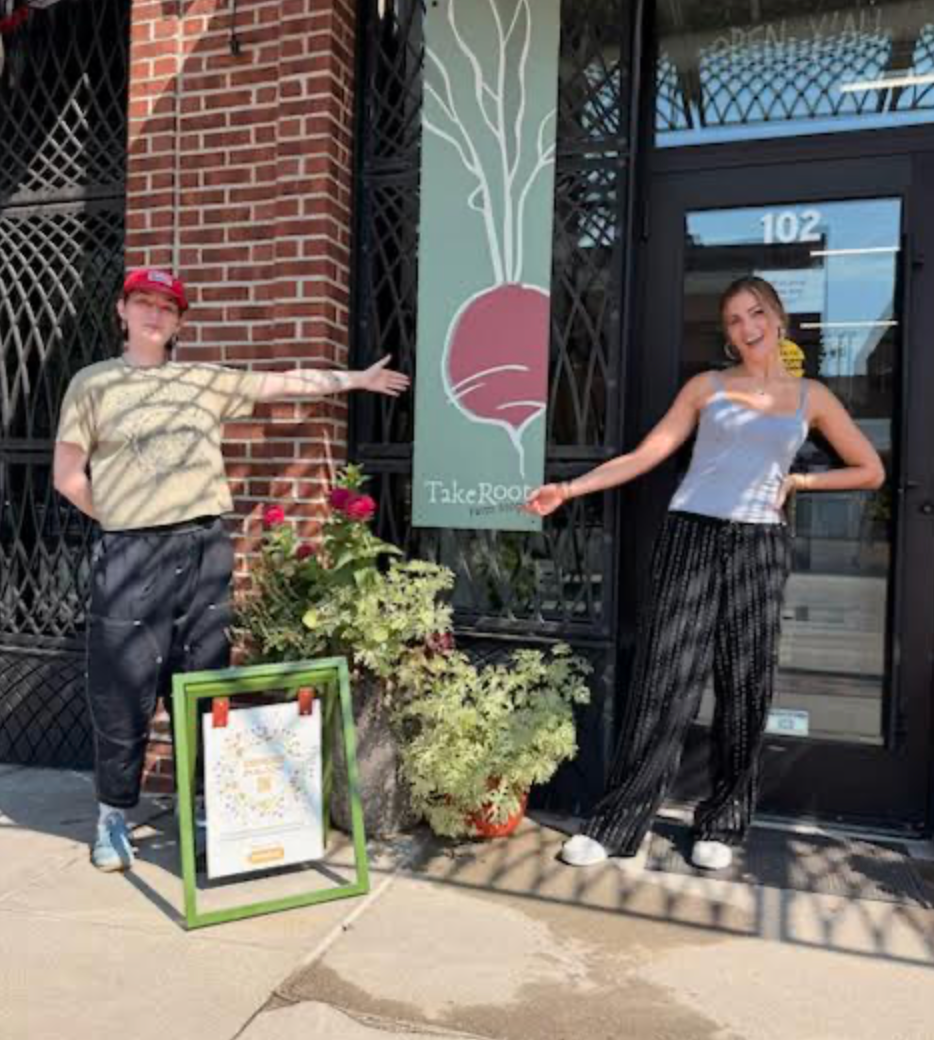
TakeRoot’s first two full-time employees, Alex Beeson (left) and Kayla Gornall (right).
MARK: What’s your job description as of right now?
CARLA: Officially, I am the store manager. Every day looks a little different, which is one of the things I love most. Thankfully, we have an amazing staff that keeps our day-to-day operations running smoothly – from sales and producer drop-offs to inventory and marketing. Their hard work allows me to focus on bigger projects such as community outreach, building relationships with new farmers and producers, and guiding them through our onboarding process. I also do the majority of the ordering.
MARK: Are you selling prepared foods at TakeRoot? And, if so, are you producing anything in-house? I just had the opportunity to visit Bobbi Boos at the Bloomington Farm Stop Collective in Indiana, and it’s got me thinking a lot about in-house food production, as they’re doing quite a bit of it.
CARLA: Prepared foods is the one category that took us longer than we thought to procure. We were able to begin selling from one vendor at about 6 weeks in, and their products quickly became some of our best sellers. We now have a couple of great prospects, and we’re excited to be able to offer them to our customers. Eventually, yes, we hope to use our kitchen to make salads, bowls and other prepared food under the TakeRoot brand.
MARK: Could you talk a little more about why you want to start in-house food production? For instance, I’m curious as to whether the idea is mainly about repurposing produce and proteins that might otherwise need to be culled, or if it’s more about filling holes that you just can’t find local producers to fill.
CARLA: We’re starting in-house food production for a number of reasons. For whatever reason, grab-n-go is the one category that’s had a slow start in our store. So we decided to start simple, with overnight oats. We’re still recipe testing, but they should be available in two weeks. Once we get our feet wet with one product, one of our employees is interested in repurposing produce that, as you mentioned, would otherwise be culled.
MARK: Given what you know about other farm stops, what, in your opinion, makes TakeRoot unique? What, if anything, are you doing differently?
CARLA: Our location is truly unique. As we discussed, we’re situated in the historic Dundee neighborhood of Omaha, which is a beautiful area that was recently recognized as a Nebraska Creative Arts District, and it’s home to many independently owned businesses. We’re grateful that we waited for a property that felt like the right fit. The neighborhood is highly walkable from all directions, with a bus stop just four blocks away.
MARK: What kind of feedback are you hearing from customers?
CARLA: Our neighbors enjoy having a store within walking and biking distance of their homes. They value the convenience of shopping locally while supporting regional farmers and producers through our farm fresh products and pantry staples. Many customers stop in weekly, while others visit monthly to stock up on locally raised meats and other regional products. They appreciate knowing that their purchases support sustainable practices and strengthen the local economy.
MARK: One thing a lot of us struggle with is how to convey the model to our customers. Do you think your customers, for the most part, understand that farmers own what’s in your produce deck, set their own prices, and get 70% of the sale price?
CARLA: Great that you brought that up! We just put up chalkboard signs as you walk in that explain the consignment model, and we’re working on large, permanent signs above our refrigerators that you can easily see from outside of the building as well. One will have the dollars given back via consignment, one will have a map of our producers, and the other two will just mention “Local Produce" and “Responsibly Raised Meat”. We try to make a point of letting our customers know, but when we’re busy, we want to make sure that our mission is clearly visible. We have a couple of very talented employees that are doing the artwork!
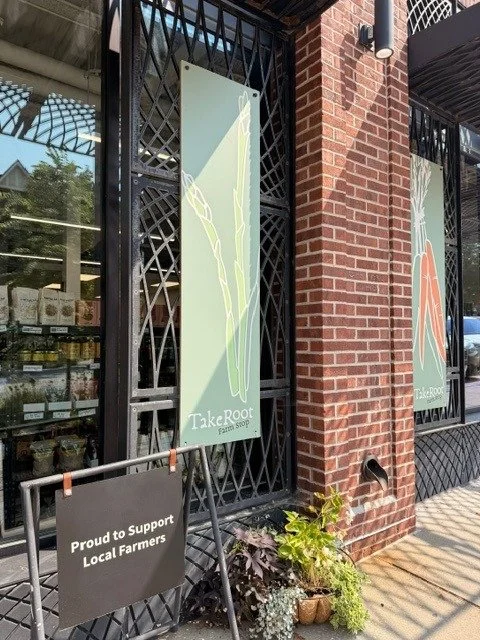
Signage outside TakeRoot Farm Stop in Omaha.
MARK: How about your farmers? What kind of feedback are you getting from them? How are they taking to the consignment model?
CARLA: The farmers are really enjoying the consignment model. We’re still young enough in the process that we’re able to keep inventory updated in our system, so they can sign into our producer portal and see what they’ve sold, and what they need to restock.
MARK: You mention that you’re able to keep the system updated as the farm stop is still young. Do you anticipate getting to a point when that’s no longer practical?
CARLA: We hope to continue, but will need to discuss with the farmers that we can’t guarantee 100% accuracy, but that will remain our goal.
MARK: What software are you using to track inventory in the producer portal?
CARLA: RetailEdge, but we also use Seeger Works to get the data to display on our Producer Portal.
MARK: When I think of Omaha, I think of really large farms growing commodity crops. What’s the small farming scene like? How many specialty crop farms do you have operating in the area, and how are they doing?
CARLA: The soil on the eastern side of Nebraska and the Western side of Iowa is very fertile. Based on the 2022 farm census, though, only 3.5% of the crops in Nebraska are specialty crops. As for farm size, farms of up to 10 acres account for just 7%. When you include farms of up to 49 acres, you account for 24% of Nebraska farms. So, yes, small specialty crop farms are in the minority.
MARK: Let’s go back in time a bit. How many farms did you launch TakeRoot with? And how did you do your outreach? Would I be right to assume that, in large part, you were relying on people you knew from your CSA days, and farmers that Gordon and Matt had personal relationships with?
CARLA: Yes, we got things started with our collective contacts. We were able to launch with about 25 farms. Since we opened in December, though, not all of those farms had products on the shelves at first.
MARK: How many farms are selling through TakeRoot right now?
CARLA: We now have almost 50 farmers and ranchers, and a total of just over 100 consignors.
MARK: You can’t prepare for everything. When you launched, I’m sure there were some things that you’d wished that you’d spent more time on. Is there something that comes to mind, that you think others who are in the process of starting farm stops might benefit from?
CARLA: In our particular area, I wish we would have had coffee drinks up and running. We weren't sure if it would be a big seller since we have several other cafes very close, but we’ve been surprised how many people are grabbing a cup. Right now, it’s typically iced lattes to-go.
MARK: I know that, given your geography, and the farms in your area, you’re having to take a more regional approach than, say, Argus. Can you talk a bit about how you approach sourcing, and what kinds of systems you’ve had to put in place in order to keep your produce deck full?
CARLA: We had a lot of space to fill in when we opened on December 6! It was almost a blessing that our produce deck wasn’t delivered for a few months. We had plenty of sweet and regular potatoes, onions, winter squash and garlic to start with, but, when supplies started running low, we ordered from various food hubs in Iowa. Iowa has a network of 5 hubs that move produce and products throughout the state. We hope we can grow the farmer network in Nebraska to be able to do the same. Since Omaha is on the Nebraska-Iowa border, we source products as close to Omaha as possible. If we can’t find it, we then look at various websites that list farmers in the two states, as well as on the food hub websites. We are considering getting fruit outside of the two state region, until we have farmers that can provide enough, but it will be in a state that borders either Nebraska or Iowa. We hope that our farmers will be able to ramp up their production so we can keep our produce within the two states!
MARK: I know it’s early still, but do you have any examples of farms growing or expanding to take advantage of this new direct-to-consumer market that you’ve created in Omaha? Specifically, I’m interested in fruit, as I’ve heard the same thing from other farm stop operators. I’m curious if you’re hearing anyone talk about expanding their operations in that area.
CARLA: Yes! We have two farms that have, and are planting more strawberries. It’s a small start, but nonetheless a start. It will take a few years with other fruit, but we’ve put out the request. We are also partnering with the Horticulture Department of Metropolitan Community College here in Omaha, and hoping they will experiment and grow with us.
MARK: I like the approach of sourcing regionally, but always with the objective of bringing supply chains closer to the store when opportunities arise. I know, in Ann Arbor, when Argus launched, there wasn’t local yogurt, for instance. In time, however, that came. Other than fruit, and the prepared foods that we’ve discussed, what else is on your local wish list? Are there other things you’d like to get closer to home?
CARLA: Yes, we do have a list of things we would like to bring closer. Top on the list would be nut butters. It costs almost $2 per bottle to ship from southern Missouri, and I think it would be an ideal start-up closer to the Omaha Metro area.
MARK: I noticed, when I was at the farm stop in Bloomington this summer, that they had a new, local sunflower oil producer. It caught my attention because we now have one of those here in Michigan as well. It’s interesting to see how communities with farm stops are evolving to fill local gaps.
CARLA: Yes, one of our goals is to grow entrepreneurs, whether they be farmers or value-added producers. Since our local community college, Metro Community College, has a joint culinary program and a horticulture program, we feel like students will find TakeRoot a good place to test their ideas, refine their products and gain valuable market experience.
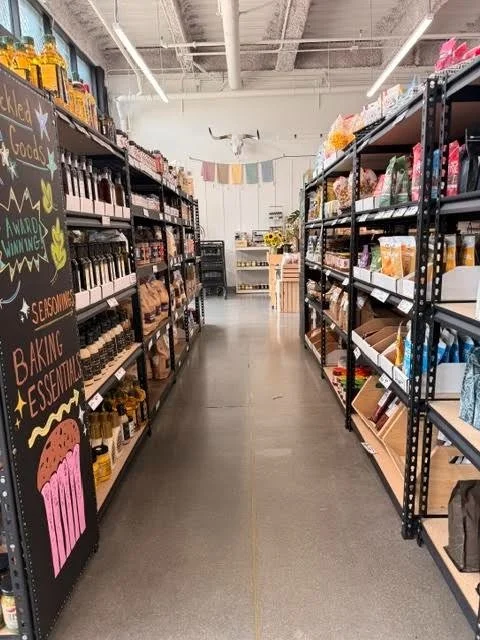
A view down the baking aisle at TakeRoot.
MARK: How far are your farms, on average, traveling to make deliveries to you, and does that present any challenges?
CARLA: An average would be hard to come up with, as we have urban farmers anywhere from 2 miles down the road to farms 100 miles away that drop off on a weekly basis over the summer. For the farms that are further away, we are on their “Omaha delivery routes” and they keep a good eye on their inventory to know what to bring each week. Gordon lives about 45 minutes northwest of the store, so he often picks up produce from farms on his way into town a couple of times per week.
MARK: Can you give us an example of a farm that you’re excited to be working with?
CARLA: I received my Small Market Farming Certificate 6 years ago from Metro Community College. While there, I worked at Iowana Farm in order to get “hands-on” learning. I used to pick tomatoes with the owner, Terry, late in the afternoon. Well, Terry just dropped off her heirloom tomatoes this week, and was such a joy to reconnect. I also enjoy selling fresh produce and eggs from a few other local farmers I met during my time in the program. Supporting these hardworking growers that I’ve known for years really means a lot to me.
MARK: Can you talk a minute about the decision to open in December, and without a produce deck?
CARLA: Located in a larger city than most farm stops, we found it difficult to find a location. We knew it had to meet a lot of parameters for us to commit to a lease. When we found the building in Dundee, it checked most of the boxes, and although it was more that we wanted to spend, we felt the location and building were ideal so we signed the lease in July. The space required minimal renovations for our commercial kitchen and electrical needs, but as with any new business, preparing for opening still took time. Since we knew we were opening in the winter, the produce deck wasn’t a high priority, as we had plenty of glass front refrigerators for the greens and root vegetables. After the holidays, we relied on a solid mix of meats, dairy, dry goods and produce, with our two biggest sales categories being meat and produce.
MARK: What’s the next milestone on the horizon?
CARLA: We just hit the $200,000 mark back to our consignors! I would love to see 3 new grab-n-go vendors. As I mentioned before, it’s the category that we have continuously been trying to fill. We have two vendors very interested, and one just sent an email that she hopes to begin drop-offs next week. Fingers crossed that it happens!
MARK: Assuming you haven’t already, when do you project reaching break-even? And what does break-even look like? How many customers would you need per day, do you think, to make things sustainable?
CARLA: I asked Matt Johnson for help with this question and here’s his current estimate – if things remain as they are, he thinks it would be between 36-48 months from today to breakeven (pay existing debt and recover owner investment). A $30 average ticket, and an average of 84 customers per day would make the business sustainable. This would make us operationally sound, and allow us to slowly build a reserve.
MARK: What advice do you have for others who might be getting ready to launch a farm stop in communities like Omaha?
CARLA: My advice would be to assemble a great team, whether it be partners or employees that share the vision of creating a successful market. Another idea would be to host a public interest meeting, or to have a public comment period in which to share what the community would like to see in terms of products, experiences or services so that the market reflects what they’re looking for or interested in.
MARK: You’ve been to three Farm Stop National Conferences now. Assuming you come to this next one in March, it’ll be your first as an actual operator. As we’re working on the agenda now, I’d love to know your thoughts on what you’d find useful at this point?
CARLA: I think a breakout session on social media and creative advertising would be a great topic. Perhaps a session on creating an employee handbook – we found that to be helpful as a farm stop in a suburban area. A third idea would be a session on the importance of merchandising, how best to present produce in order to convey abundance, and best storage practices. Topics could include proper storage temperatures, produce handling techniques, and which fruits and vegetables should not be stored or displayed together, such as onions and tomatoes, to help preserve freshness and extend shelf life.
MARK: I’m curious as to your grocery support network. I know you’ve gone through the Argus trainings, and attended three conferences now, but I’m curious to what extent you’ve engaged with others in the Farm Stop community. Is there anyone else that you’re going to for advice?
CARLA: It’s been a team effort! We have several friends in the food business that have shared advice, and many of our guests have offered ideas. We genuinely considered their feedback and have implemented many of their suggestions. As far as grocery support, we have relied primarily on Argus for advice, but we did meet with someone a couple of times that had operated a store in our neighborhood a few years ago. He had some great ideas, and donated some of his shelving prior to opening.
MARK: Can you share one story from your first six months of operating TakeRoot – something that made you really happy? I’m just wondering if there was a moment when something happened, and you thought to yourself, “OK, I know I’m where I’m supposed to be. Opening TakeRoot was the right thing.”
CARLA: It may seem like a small thing, but less than three weeks after we opened, a guest came in with a shopping list. It made the farm stop feel like a grocery store and not just a gift store for the first time!
Check out TakeRoot and subscribe to their weekly newsletter on their website, https://www.takerootfarmstop.com/. When you’re in the area, visit them at 5018 Underwood Ave Ste 102, Omaha.